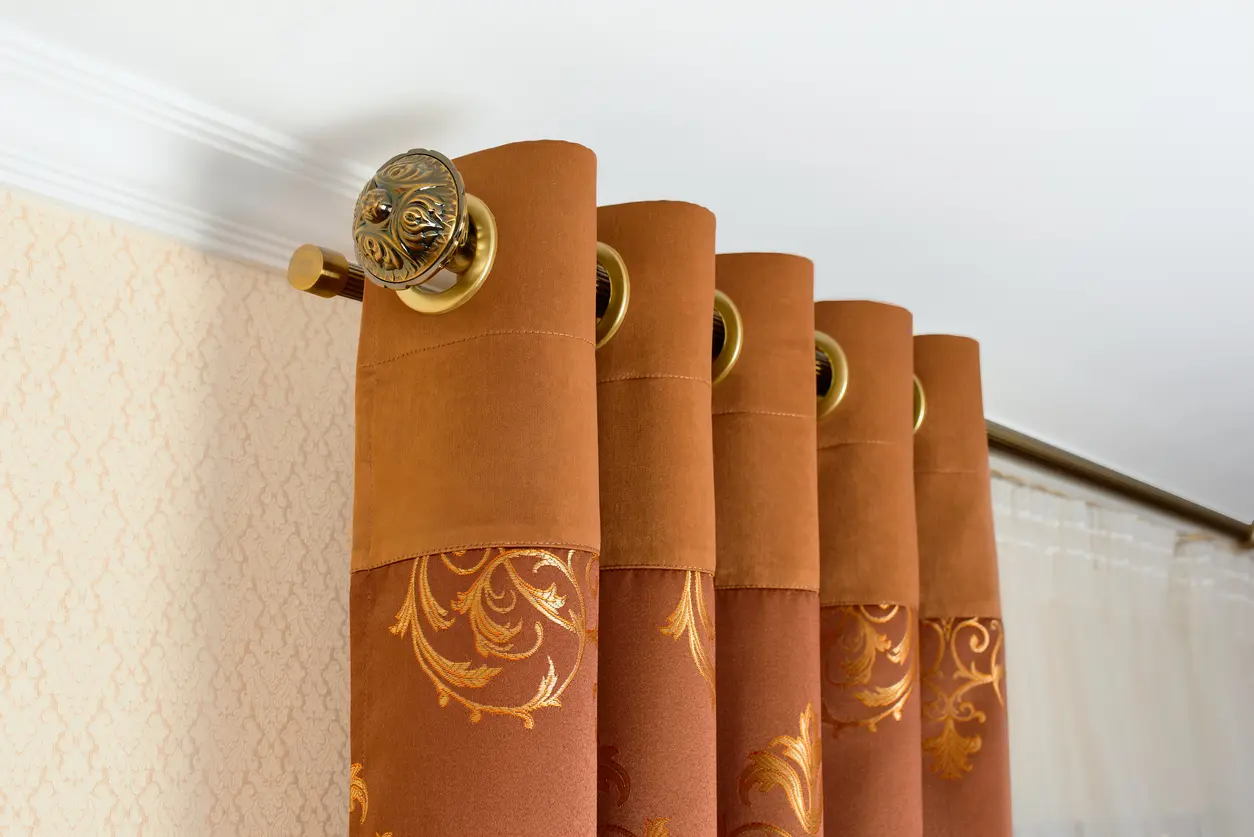

Curtain poles affect the finished look of a room far more than many people expect. Although they are functional fittings, they also frame the window, support the weight of the curtains and influence how tall, wide, formal or relaxed the space appears.
The right curtain pole should feel proportionate to the window, the curtains and the room around it. A pole that is too short, too thin or positioned too close to the window can make even beautifully made curtains look restricted. A carefully selected and properly fitted pole can help the fabric hang correctly, preserve natural light and make the whole window treatment feel intentional.
Material, diameter, colour, brackets and finials all contribute to the final result. The pole does not always need to become a prominent decorative feature, but it should relate naturally to the wider interior.
Why does the curtain pole matter to the overall design?
Curtains do not sit in isolation. Their appearance depends on the support system above them.
The pole establishes the top line of the window treatment and affects where the curtains begin, how they stack when open and how the fabric falls towards the floor. This can change the perceived proportions of both the window and the room.
A well-positioned curtain pole can help:
- Make a window appear wider
- Create a greater sense of ceiling height
- Allow curtains to clear the glass when open
- Frame the window more generously
- Support even, balanced pleats
- Connect the curtain treatment with other finishes in the room
A poor choice can have the opposite effect. A narrow pole may cause the curtains to cover too much of the glazing, while an undersized diameter can look visually weak beneath heavy fabric.
The pole should therefore be chosen as part of the complete curtain design rather than treated as a last-minute practical fitting.
How does pole position affect the proportions of a room?
The height and width of the curtain pole strongly influence how the window is perceived.
A pole fitted directly above the window frame can make the treatment feel contained and compact. A pole positioned higher can draw the eye upwards and create the impression of greater height.
Similarly, extending the pole beyond both sides of the window allows the open curtains to stack partly against the wall instead of covering the glass. This can make the window appear wider and allow more daylight into the room.
Should a curtain pole be fitted above the window?
In many rooms, fitting the pole above the window frame creates a more balanced and elegant result.
The exact height depends on:
- The distance between the window and ceiling
- The style of the room
- The curtain heading
- The length of the curtains
- Nearby architectural details
- The position of coving or decorative mouldings
Where there is generous wall space above the window, a higher pole can add height and make full-length curtains feel more substantial.
In a room with low ceilings, raising the pole may help create stronger vertical lines. However, fitting it too close to the ceiling without considering the proportions can make the treatment feel disconnected from the window.
The aim is to create a visual relationship between the top of the curtains, the window and the ceiling.
How far should the pole extend beyond the window?
The pole should normally extend beyond the window frame far enough for the curtains to stack without covering excessive glazing.
The required extension depends on the amount and thickness of fabric. Full, interlined curtains need more stack-back space than lightweight unlined curtains.
A wider pole can:
- Reveal more of the window when the curtains are open
- Increase natural light
- Make the glazing appear broader
- Create a more generous frame
- Prevent bulky fabric from crowding the window
However, the surrounding wall space must be considered. A pole should not interfere with cupboards, shelving, wall lights or an adjacent window.
Professional measuring is useful because the ideal width is based on the actual curtain specification rather than a standard allowance alone.
How does curtain pole diameter affect the finished look?
The diameter of the pole should feel proportionate to the scale and weight of the curtains.
A slim pole can look refined and understated with light fabrics and smaller windows. A thicker pole often works better with wide windows, tall ceilings and heavier curtains.
If the pole is too thin for the curtains, it may look visually weak and may not provide sufficient structural support. If it is too thick for a modest window, it can dominate the wall and make the treatment feel heavy.
When does a slim curtain pole work well?
A slim pole may suit:
- Small or narrow windows
- Lightweight curtains
- Simple contemporary interiors
- Rooms with limited space above the window
- Curtains intended to look delicate and understated
A narrow metal pole can create a clean and minimal line, particularly when matched to other fittings in the room.
The brackets and finials should also remain appropriately scaled. Large ornamental ends on a very slim pole can look unbalanced.
When is a thicker curtain pole more suitable?
A larger-diameter pole may be appropriate for:
- Wide windows
- Tall rooms
- Heavy lined curtains
- Interlined curtains
- Generous tailored pleats
- Stronger decorative schemes
- Period properties with substantial architectural details
A thicker pole has greater visual presence and can balance a large expanse of fabric.
It may also be needed for practical reasons, as wide or heavy curtains require stronger support. The centre of a long pole may need an additional bracket to prevent sagging.
The structural requirements should be established before the decorative finish is chosen.
How do different materials change the appearance?
Curtain poles are available in a range of materials, each creating a different visual effect.
The most suitable option should relate to the curtain fabric, furniture, lighting, door furniture and other finishes already present in the room.
What look do wooden curtain poles create?
Wooden curtain poles can introduce warmth, texture and a traditional or natural quality.
They work particularly well with:
- Linen and cotton fabrics
- Traditional prints
- Country-inspired interiors
- Period properties
- Timber furniture
- Warm and earthy colour schemes
The appearance can range from simple and contemporary to detailed and decorative depending on the profile, stain and finial.
A pale timber pole can create a relaxed Scandinavian or natural look, while dark-stained wood may feel more formal and substantial.
Painted wooden poles can also be coordinated with walls, skirting boards or window frames. This allows the pole either to blend quietly into the room or provide deliberate contrast.
Wooden poles tend to have more visual weight than very slim metal designs, so their scale should be considered carefully in smaller rooms.
How do metal curtain poles affect the room?
Metal poles can create a crisp, refined or industrial appearance depending on their finish.
Popular metal effects may include:
- Polished chrome
- Brushed steel
- Antique brass
- Aged bronze
- Satin nickel
- Matt black
- Warm metallic finishes
A slim black pole can add definition to a modern room without appearing ornate. It may coordinate with black-framed glazing, light fittings or cabinet handles.
Brass or bronze finishes can introduce warmth and work well with rich fabrics, traditional interiors and layered colour schemes.
Chrome and nickel may suit cooler contemporary rooms, although highly polished surfaces can feel more visually prominent because they reflect light.
The finish should not necessarily match every metal element exactly. A considered combination of related tones can feel more natural than trying to make all fittings identical.
Can a curtain pole be painted to match the walls?
A pole painted to match or closely relate to the wall colour can create a subtle, integrated effect.
This approach may be useful where the curtains should remain the main focus and the hardware needs to recede visually.
It can work particularly well with:
- Calm tonal schemes
- Small rooms
- Detailed fabrics
- Minimal interiors
- Period rooms with painted joinery
- Windows positioned close to the ceiling
A contrasting pole creates a stronger horizontal line. A matching pole feels quieter and may make the window treatment appear less visually busy.
The brackets and rings should also be considered. A painted pole combined with contrasting metal brackets may interrupt the intended effect unless the contrast is deliberate.
How do curtain pole finishes relate to other room details?
The curtain pole can help connect different elements across the room.
For example, a warm brass pole may relate to cabinet handles, wall lights and picture frames. A black pole may echo a fireplace surround, table legs or window frames.
The relationship does not need to be exact. Repeating a finish in small amounts can create visual continuity.
Consider the pole alongside:
- Door handles
- Light switches
- Lamps and pendants
- Furniture frames
- Mirrors
- Picture frames
- Fireplace details
- Window catches
- Curtain tiebacks
Too many unrelated finishes can make a room feel fragmented. However, using only one finish everywhere can sometimes appear overly coordinated.
A balanced scheme usually includes a dominant finish and one or two supporting materials.
What are finials and why do they matter?
Finials are the decorative end pieces fitted to either side of a curtain pole.
They help complete the pole visually and prevent curtain rings from moving off the ends. Their shape can influence whether the treatment feels minimal, traditional, elegant or decorative.
Finials range from simple caps to more elaborate designs.
Options may include:
- Plain end caps
- Rounded shapes
- Ball finials
- Faceted forms
- Spear-like designs
- Decorative scrolls
- Carved wooden ends
- Glass or crystal details
The finial should suit the scale of the pole and the amount of wall space available.
A large decorative finial may require additional clearance beyond the pole itself. This can create problems where the window is close to a corner, wardrobe or wall light.
When should you choose simple finials?
Simple end caps or understated shapes are often the best option in contemporary rooms.
They allow the curtain fabric and overall proportions to remain the focus. A plain finial can also help a larger pole feel less dominant.
Simple designs suit:
- Minimal interiors
- Geometric curtain patterns
- Small rooms
- Strong architectural windows
- Spaces with several decorative features
- Rooms where the pole should blend into the background
Understated does not mean unconsidered. The size, finish and alignment should still feel deliberate.
When do decorative finials work best?
Decorative finials can add character where the pole is intended to become part of the room’s detailing.
They may suit:
- Period properties
- Formal sitting rooms
- Traditional bedrooms
- Luxurious fabrics
- Decorative cornices
- Classical furniture
- Rooms with generous wall space
The design should relate to the wider interior rather than appearing as an isolated ornament.
Highly decorative finials combined with heavily patterned fabric and elaborate furniture can become visually overwhelming. A more restrained finial may provide better balance.
How do brackets affect the finished appearance?
Brackets are primarily structural, but they are also visible parts of the curtain pole system.
They determine how far the pole projects from the wall and must support the curtain weight safely.
The bracket depth affects how the curtains hang in relation to:
- Window handles
- Deep window sills
- Roman blinds
- Voile panels
- Radiators
- Decorative mouldings
- Secondary curtain tracks
A pole fitted too close to the wall may cause the curtains to catch on the window frame or other treatments.
A pole fitted too far forward can look detached from the window and occupy unnecessary space.
The brackets should be aligned carefully and fixed into suitable material. Uneven brackets can cause the pole and curtains to sit at an angle, which will undermine the quality of the finished treatment.
When is a centre bracket required?
A centre bracket may be needed for a long pole or a heavy pair of curtains.
Without sufficient support, the pole may sag in the middle. Even a small amount of deflection can become visually obvious when the curtain heading follows an uneven line.
The need for additional support depends on:
- Pole material
- Pole diameter
- Overall width
- Curtain weight
- Type of wall fixing
- Manufacturer’s recommendations
The centre bracket can affect how the curtains operate. Standard passing rings or a specialist system may be required if the curtains need to move across the support point.
This should be planned before the curtains are made.
How does the curtain heading relate to the pole?
The curtain heading and pole should be selected together because they affect one another visually and functionally.
Some headings are designed to hang from rings, while others can be threaded directly onto the pole.
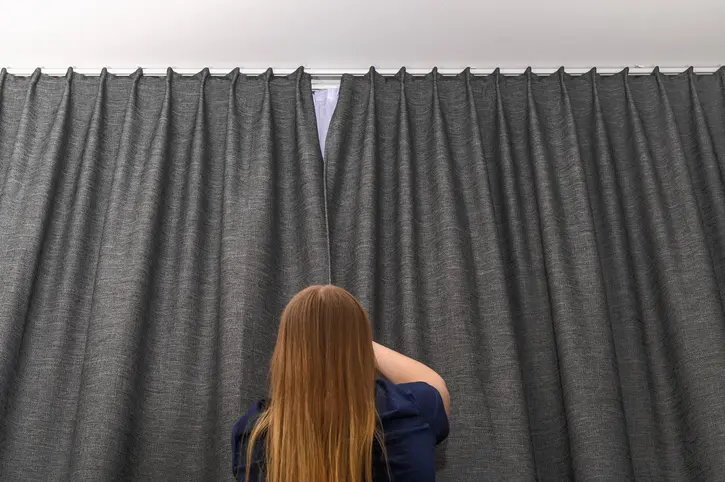
How do tailored pleats look on a curtain pole?
Tailored pleat headings create structured folds at the top of the curtain.
When suspended from rings beneath a visible pole, the heading creates a formal and carefully finished appearance. The spacing of the hooks and rings should be even so the pleats hang consistently.
This combination can work well with:
- Plain linen blends
- Textured fabrics
- Formal living rooms
- Principal bedrooms
- Traditional and transitional interiors
- Tall, full-length curtains
The pole should have enough visual strength to balance the tailored heading and fabric volume.
A very slim pole may look too delicate beneath a substantial pleated curtain.
How do eyelet curtains change the appearance of the pole?
Eyelet curtains are threaded directly onto the pole through metal rings set into the fabric.
Because the pole passes through the heading, it becomes a very visible part of the treatment. Its colour and diameter need to coordinate closely with the eyelets.
Eyelet curtains create broad, even folds and often suit contemporary interiors.
However, they require enough space above and behind the pole for the fabric to move. The pole must also be easy to access if the curtains need to be removed.
The eyelet finish should relate to the pole. Combining different metal tones without a clear design reason can make the treatment feel mismatched.
What is the difference between a curtain pole and a track?
A curtain pole is usually visible and forms part of the decorative design. A curtain track is generally more discreet and may be concealed behind the curtain heading, within a recess or beneath a pelmet.
A pole may be preferable where:
- Decorative hardware is desired
- The window has sufficient wall space
- The curtains suit rings or eyelets
- The interior needs a strong framing detail
A track may work better where:
- The curtains are very wide or heavy
- Smooth operation is a priority
- The window is curved or bay-shaped
- The fitting needs to be discreet
- The curtains run close to the ceiling
- A pelmet will conceal the hardware
The choice affects the final character of the room. Poles tend to feel more decorative and architectural, while tracks can create a cleaner and more seamless result.
Can curtain poles make a small room look larger?
A correctly positioned pole can help improve the proportions of a small room.
Fitting the pole higher draws the eye upwards, while extending it beyond the window allows the curtains to clear more of the glass. This increases visible daylight and can make the room feel more open.
Choosing a finish that blends with the wall may also reduce visual interruption.
In a compact room, consider:
- A slim but structurally suitable pole
- Simple finials
- Full-length curtains
- A higher fitting position
- Sufficient width for stack-back
- A finish that relates to the walls or window frame
Very large decorative finials, thick dark poles and bulky curtain stacks may make a small room feel crowded.
The aim is not necessarily to make every fitting disappear. It is to keep the scale controlled and balanced.
How do curtain poles influence full-length curtains?
Full-length curtains create strong vertical lines, but the pole establishes where those lines begin.
A higher pole can enhance the sense of height and allow the curtains to fall in a more generous column.
The final length should be measured from the selected pole position. Changing the height after the curtains have been made can leave them too short or cause excessive fabric to gather on the floor.
The pole should therefore be installed or its exact position confirmed before final curtain measurements are taken.
The desired lower finish also matters. Curtains may:
- Finish just above the floor
- Lightly touch the floor
- Break slightly at the bottom
- Pool more generously
The pole height and curtain length must work together to create the intended result.
Do bay windows need specialist curtain poles?
Bay windows often require specialist planning because the curtain system must follow multiple angles.
A standard straight pole may not be suitable. Options can include:
- Bent metal poles
- Jointed wooden or metal poles
- Passing-ring systems
- Separate poles for each section
- Flexible or made-to-measure tracks
The best solution depends on the shape of the bay, the weight of the curtains and how far they need to travel.
Passing brackets may allow rings to move around corners and across support points, but the curtain heading and ring type must be compatible.
A poorly planned bay system can make curtains difficult to operate and create uneven stacking. Accurate measuring and specialist fitting are particularly important.
Should the pole be visible or concealed?
A visible pole can add definition and reinforce the style of the room. A concealed system creates a quieter and more architectural finish.
A visible pole may be appropriate when:
- The hardware has been carefully selected
- Decorative finials are part of the design
- The room includes related metal or timber details
- The curtains have a ring or eyelet heading
A concealed track or pole may be better when:
- The fabric should be the main focus
- The interior is highly minimal
- The curtains run from ceiling to floor
- A pelmet or recessed detail is being used
- The window shape makes visible hardware awkward
Neither approach is automatically more refined. The quality of the proportions, installation and relationship with the room matters more than visibility alone.
What practical factors should be considered?
The curtain pole must work structurally as well as visually.
Before choosing a design, consider:
The weight of the curtains
Heavy lined or interlined curtains need a strong pole, appropriate brackets and secure wall fixings.
The wall construction
Plasterboard, masonry, timber and older wall surfaces require different fixings. The pole must be attached safely to a suitable supporting material.
Window obstacles
Handles, shutters, blinds and opening sections may affect the required bracket projection.
Curtain movement
The curtains should open and close smoothly without catching on brackets or decorative details.
Available space
Finials and curtain stacks need clear wall area. Nearby cupboards, shelves and radiators should be taken into account.
Maintenance
The pole and rings should be accessible if curtains need to be removed for cleaning or adjustment.
How can poor pole selection affect the curtains?
Even high-quality curtains may not hang properly if the pole is unsuitable.
Common problems include:
- The pole bending under the curtain weight
- Curtains covering too much glass when open
- Fabric catching on window handles
- Uneven folds caused by incorrect ring spacing
- Brackets positioned too close together
- Finials feeling out of scale
- The pole appearing too short for the window
- Curtains finishing at the wrong height
These issues can make the treatment look improvised rather than bespoke.
Planning the pole, heading, fabric and fitting as one complete design helps avoid compromises later.
Frequently Asked Questions
Should curtain poles match the curtain fabric?
They do not need to match exactly. The pole should coordinate with the fabric and wider room finishes. A contrasting pole can add definition, while a related tone creates a quieter effect.
Can any curtain pole hold heavy curtains?
No. Heavy lined or interlined curtains require a pole with a suitable diameter, material, bracket spacing and weight capacity. The wall fixings must also be appropriate.
Should the curtain pole be wider than the window?
Usually, yes. Extending the pole beyond the window allows the curtains to stack away from the glazing and can make the window appear wider.
Are wooden or metal curtain poles better?
Neither is universally better. Wooden poles provide warmth and visual substance, while metal poles can create a slimmer and more contemporary look. The choice depends on the curtain weight and room style.
Do you choose the pole before measuring the curtains?
Ideally, the pole and its position should be decided before final curtain measurements are taken. This ensures the finished curtain length and width relate accurately to the installed hardware.
Choosing a curtain pole that completes the room
A curtain pole is not merely a support for fabric. It defines the upper edge of the window treatment and affects the scale, height and balance of the room.
The most successful choice will reflect the weight and style of the curtains, the proportions of the window and the finishes already used throughout the interior. Its position should allow the curtains to frame the glazing without unnecessarily restricting natural light.
Diameter, brackets and finials should be considered together, with structural performance given the same attention as appearance. When every element is properly proportioned, the pole helps the curtains look more generous, refined and integrated with the room.
For advice on selecting curtain poles, tracks and made-to-measure curtains that work together as a complete window treatment, contact Zenn Interiors for a personalised consultation.
Phone: 020 7871 3082
Email: zenninteriors@gmail.com
Find out more: https://zenninteriors.co.uk/