Electric blinds can make window treatments easier to use, especially where blinds are large, numerous or difficult to reach. They can also create a cleaner finish by reducing the need for visible operating chains and allowing several blinds to be controlled together.
However, installing electric blinds successfully involves more than simply choosing a fabric and adding a motor.
Before committing to motorisation, you need to consider the window itself, the size and weight of the blind, how the motor will receive power, where controls will be located and how easily the system can be accessed if maintenance is ever required.
The best results usually come when these decisions are made early, particularly during a renovation, extension or wider interior design project.
Zenn Interiors offers electric blinds as part of its made-to-measure blind range, alongside roller, Roman, Duette, cassette and other blind types. That makes it possible to consider motorisation as part of the overall room scheme rather than treating it as a separate technical feature.
When are electric blinds most useful?
Motorisation can be useful on almost any suitable blind, but it becomes particularly valuable where manual operation would be inconvenient.
Common examples include tall windows, windows behind furniture, large areas of glazing and rooms with several blinds positioned next to one another.
Imagine an open-plan extension with four blinds across a large rear elevation.
Opening and closing all four manually every morning and evening may not seem especially difficult at first, but it becomes a repetitive task. If the blinds also need adjusting during the day to reduce glare, motorisation can make the whole system much easier to manage.
Electric operation can also be useful where blinds are fitted above:
- kitchen worktops
- staircases
- furniture
- deep window recesses
- tall glazed doors
- hard-to-reach windows
The benefit is not simply that electric blinds feel more luxurious. Their real value is convenience.
If a blind can already be operated comfortably by hand and is rarely adjusted, motorisation may add relatively little. If it is difficult to reach or needs frequent adjustment, the practical benefit becomes much greater.
Are electric blinds suitable for every window?
Not automatically.
The suitability of motorised blinds depends on several factors, including the blind type, window dimensions, available fitting space and weight of the finished blind.
A small standard window presents a very different technical challenge from a wide glazed door.
The larger the blind, the more load is placed on the operating mechanism. Motor selection therefore needs to be appropriate for the blind’s dimensions and construction.
There must also be enough space for the headrail, motor and associated components.
This is one reason accurate measuring is particularly important for electric blinds.
A few millimetres can affect whether the system sits neatly within a recess, clears a window handle or operates without catching against surrounding trim.
Before deciding that a particular window should be motorised, it is useful to establish:
- the window width and height
- the available recess depth
- whether the window opens inward
- the position of handles
- the weight of the chosen blind
- whether the blind will be recess or face fitted
- how the motor and power source will be accommodated
The appearance of the finished blind matters, but the installation geometry comes first.
What power supply do electric blinds need?
This is one of the most important issues to consider before installation.
Motorised blinds need a source of power, but the exact arrangement depends on the system being used.
Some systems may use a mains electrical supply, while others can use rechargeable or battery-based power.
The practical implications are quite different.
Mains-powered systems
A mains-powered blind can be convenient where a permanent power supply can be incorporated discreetly.
This may be particularly suitable during a renovation or new extension when electrical work is already being carried out.
Planning the supply early can help conceal wiring and avoid the need to route visible cables around a finished room later.
If the blinds are being installed as part of a wider building project, discussing their electrical requirements before plastering and decorating can therefore make the final result much neater.
Electrical work should, of course, be undertaken appropriately by a competent person where required.
Battery or rechargeable systems
Battery-powered or rechargeable options can reduce the need for fixed wiring.
This can be useful in an existing room where adding a new electrical supply would be disruptive.
However, convenience needs to be weighed against future charging or battery maintenance.
Ask yourself how easy the motor will be to access once the blind is fitted.
A rechargeable blind at normal window height may be simple to maintain. A blind several metres above floor level presents a different situation.
The power system should therefore be considered over the entire lifetime of the blind, not just during installation.
Should wiring be planned before decorating?
Where a wired system is being considered, ideally yes.
Electric blinds are easier to integrate discreetly when their power requirements are known before walls, ceilings and window surrounds are finished.
This is particularly relevant in contemporary interiors where the aim is often to keep technology visually unobtrusive.
Planning early may allow cables and connection points to be incorporated into the architecture instead of added afterwards.
This can be especially important around:
- large glazed extensions
- recessed blind pockets
- ceiling-mounted systems
- floor-to-ceiling windows
- groups of motorised blinds
Retrofitting electric blinds can still be possible, but the installation options may be more limited once all decorating and joinery are complete.
For anyone planning a substantial refurbishment, it therefore makes sense to decide whether motorisation is likely before the finishing stages begin.
Which control method should you choose?
Electric blinds can potentially be controlled in several ways depending on the selected system.
The most appropriate option depends on how the blinds will actually be used.
Zenn Interiors describes electric blind options with remote and app-based operation, providing different ways to control the window treatment.
Remote control
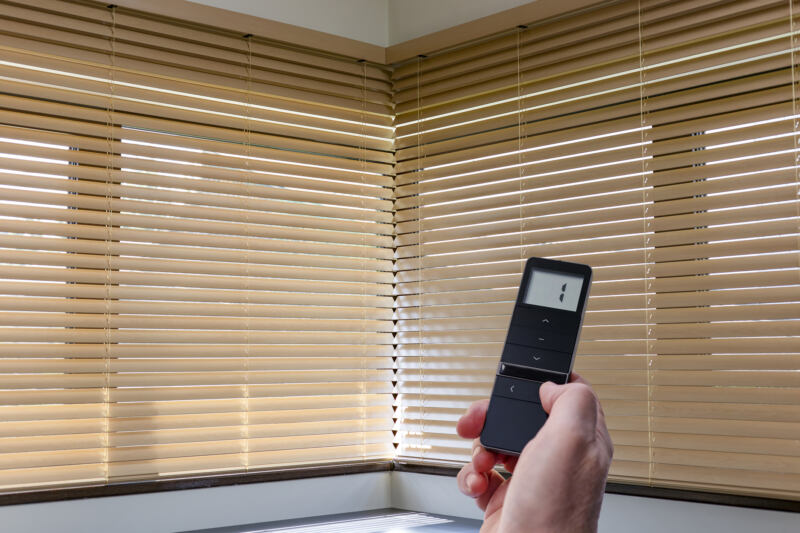
A handheld remote can be one of the simplest options.
It provides straightforward control without requiring someone to walk over to each window.
This can work especially well where several blinds are grouped into one area.
App control
App-based systems can offer another level of convenience, particularly for households that already use connected technology.
The exact features depend on the motor and control system.
Before selecting an app-controlled blind, consider whether everyone who regularly uses the room will be comfortable with that control method.
Technology is most useful when it simplifies daily life.
A system that requires a phone for every small adjustment may be less convenient for some households than a straightforward remote.
Should blinds be controlled individually or as a group?
This deserves careful thought in rooms containing several electric blinds.
Grouping blinds allows multiple window treatments to move together.
For example, all blinds across one glazed wall could potentially be lowered at once.
That can create a very neat visual effect and saves time.
However, there will also be situations where individual control matters.
Suppose one section of a large window receives direct afternoon sun while the others remain shaded. You may want to lower only that blind rather than darkening the entire room.
The most flexible arrangement can therefore be one that allows both grouped and individual operation, where the chosen system supports it.
Think about how sunlight moves through the room throughout the day.
That often gives a better indication of how the controls should be organised than simply grouping blinds according to which wall they are on.
Does blind size affect motorisation?
Yes.
The dimensions and weight of a blind have a direct impact on the mechanism required to operate it.
A motor that is appropriate for a small blind may not be suitable for a substantially larger one.
Fabric choice can also influence the finished weight.
This is why electric blinds should be specified as a complete system rather than choosing the motor separately from the blind.
The blind type, dimensions, material and operating mechanism all need to work together.
Very large windows may also be divided into more than one blind rather than covered by a single oversized treatment.
This can make operation more manageable and may allow sections of the glazing to be controlled independently.
The correct layout depends on the proportions of the window and the visual effect you want to achieve.
How does the window type affect the installation?
The design of the window can influence both the blind and the motorisation.
Consider whether the window opens inward, slides, folds or remains fixed.
A blind that looks appropriate when the window is closed may obstruct handles or interfere with opening if its position has not been planned properly.
Sliding and bifold doors require particular attention because the blind needs to coexist with moving panels.
The location of the headrail and the amount of fabric or material gathered at the top should therefore be considered alongside the door system.
For recessed installations, available depth also matters.
If the recess is shallow, there may not be enough room for the blind and motor assembly to sit neatly without projecting beyond the window reveal.
These issues are easier to resolve during specification than after the blind has been manufactured.
Should you motorise every blind in the room?
Not necessarily.
Consistency can be desirable, but motorising every window simply because one window needs it can increase complexity unnecessarily.
A better approach is to ask which blinds genuinely benefit from automation.
For example, an open-plan room might include three large motorised blinds across garden glazing and one small manually operated Roman blind beside a dining area.
Provided the colours and finishes work together, there is no reason every window needs the same operating method.
In fact, combining systems can sometimes be the more practical approach.
Motorisation should solve a problem.
If it does not make a particular blind easier to use, improve accessibility or contribute to the desired design, manual operation may remain perfectly appropriate.
How important is future maintenance?
It is worth considering before the installation begins.
Motors and electronic controls introduce components that conventional manual blinds do not have.
Even a reliable system may eventually require charging, adjustment, troubleshooting or component replacement.
The installation should therefore avoid making the mechanism unnecessarily difficult to reach.
This is especially important for blinds mounted very high or concealed within architectural details.
A beautifully integrated installation can become inconvenient if basic maintenance requires significant dismantling.
Consider:
- how the motor can be accessed
- whether batteries or charging points can be reached
- whether the blind can be removed if required
- where remote controls will be stored
- whether system instructions will be kept somewhere accessible
These are small details, but they can have a large impact several years after installation.
How should electric blinds fit into the wider interior?
Motorisation is functional, but the blind remains a significant visual element.
The fabric, colour and proportions should still be chosen with the rest of the interior in mind.
An electric roller blind may suit a contemporary space where simple lines are important.
An electric Roman blind can provide a softer decorative treatment while still offering automated operation, depending on the system selected.
In a room containing several window treatments, it can also be useful to coordinate:
- blind fabrics
- curtain fabrics
- upholstery
- wall colours
- joinery
- hardware finishes
Zenn Interiors’ wider services include blinds, curtains and upholstery, so these elements can be considered together as part of a coherent scheme rather than independently.
The presence of a motor should not dictate the design. Ideally, the technology should support the interior while remaining relatively unobtrusive.
What should you decide before placing an order?
Before finalising electric blinds, make sure the main practical decisions have already been made.
You should know:
- which windows will be motorised
- which blind type will be used
- whether power will be mains, battery or rechargeable
- whether electrical work is required
- how the blinds will be controlled
- whether blinds should work individually, in groups or both
- where the mechanisms will sit
- whether maintenance access is adequate
- how the blind coordinates with the room
If any of these questions remain unresolved, it is usually better to address them before manufacture.
Electric blinds work best when the motorisation is designed into the window treatment from the beginning rather than added as an afterthought.
What happens if electric blinds are planned too late?
Late planning does not necessarily prevent motorisation, but it can reduce your options.
For example, imagine a new extension where all plastering, decorating and joinery have already been completed before electric blinds are considered.
If a permanent electrical supply is then required near each window, adding it may mean disturbing finished surfaces.
A rechargeable system might avoid some of that work, but it could also change the original specification.
Similarly, a recess or ceiling pocket that could have concealed the blind neatly may no longer be possible once the structure is finished.
The consequences are not always serious, but earlier planning normally provides more flexibility.
Where an interior project includes extensive glazing and electric blinds are even a possibility, discussing them before the finishing stages can therefore be worthwhile.
Frequently Asked Questions
Are electric blinds noisy?
Motorised blinds normally produce some sound while moving because a motor is operating. The amount depends on the particular system, blind size and installation. If quiet operation is important, it should form part of the specification.
Can existing blinds be converted to electric operation?
It depends on the blind and its existing mechanism. Some systems may be adaptable, while others may need to be replaced with a purpose-designed motorised blind. The existing blind should be assessed rather than assuming conversion will be possible.
Do electric blinds still work if the internet goes down?
That depends on how the blinds are controlled. A system using a dedicated remote may operate independently of internet connectivity, while certain app or smart-home functions may rely on additional technology. The specific control system should be checked before installation.
Are electric blinds worth installing on small windows?
They can be, but the benefit is usually greatest where accessibility or frequent operation makes manual control inconvenient. A small, easily reached blind that is rarely moved may gain less from motorisation.
Can several electric blinds operate at the same time?
Many motorised systems can support grouped control, allowing several blinds to move together. Exact functionality depends on the chosen motor and control system and should be established during specification.
Electric blinds can make a room considerably easier to manage, particularly where windows are large, high or numerous. The most important decisions, however, are often made before the blinds themselves are installed.
Power supply, access, window dimensions, control methods and future maintenance all deserve consideration alongside fabric and appearance.
Planning these factors early gives you more freedom to create a system that looks integrated and remains convenient to use over the long term.
Zenn Interiors provides made-to-measure electric blinds alongside a wider choice of bespoke window treatments, allowing practical operation, fabric and interior design to be considered together.
Phone: 020 7871 3082
Email: zenninteriors@gmail.com
Find out more: https://zenninteriors.co.uk/