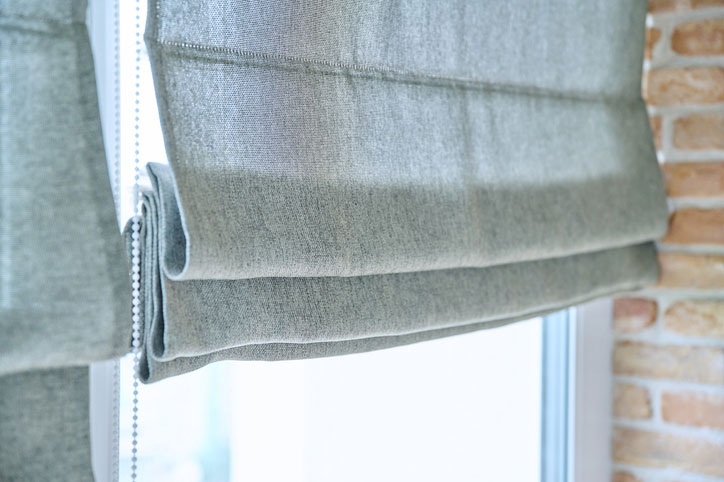
Layering Roman blinds with curtains can create a more flexible and visually complete window treatment than using either option alone.
The Roman blind provides a structured treatment within or around the window, while curtains add softness, height and a stronger decorative frame. Used together, they can also divide practical responsibilities: one layer may control light or privacy, while the other contributes insulation, texture or a more finished interior appearance.
The key is to make the two elements feel intentional.
A Roman blind and pair of curtains should not compete for attention. Their fabrics, proportions and function should work together so the finished window feels balanced rather than over-dressed.
Zenn Interiors offers made-to-measure Roman blinds and bespoke curtains, which means both treatments can be considered together as part of the wider room rather than selected independently.
Why layer Roman blinds with curtains?
The strongest reason is flexibility.
A single window treatment often has to compromise between several different requirements, including:
- privacy
- daylight
- darkness
- softness
- insulation
- decorative impact
Using two layers allows those responsibilities to be divided.
For example, a Roman blind might provide everyday privacy while the curtains remain open for most of the day. In the evening, the curtains can then be closed to add another layer of screening and create a softer atmosphere.
Alternatively, lined curtains might provide the main room-darkening function while the Roman blind is used to control sunlight during the day.
This makes layered window treatments particularly useful in bedrooms, living rooms and other spaces where the window needs to behave differently at different times.
Should the Roman blind and curtains match?
They can, but they do not need to.
Using the same fabric for both treatments can create a coordinated, traditional effect, but it can also make the window feel visually heavy, particularly if the material has a strong pattern.
In many interiors, a more balanced approach is to use complementary fabrics.
For example:
- a patterned Roman blind with plain curtains
- a textured blind with simple neutral curtains
- a plain Roman blind with more decorative curtain fabric
- related colours with different textures
- the same colour family in different tones
The aim is usually to create a relationship rather than exact repetition.
If both treatments use bold pattern, the window can quickly become dominant.
If both are extremely plain, the combination may still work, but the overall result will depend more heavily on texture and colour contrast.
Which layer should be the decorative feature?
Usually, one treatment should take the lead.
If the Roman blind uses a distinctive pattern, the curtains can provide a quieter frame.
If the curtains are made from a rich or decorative fabric, a simpler blind can prevent the scheme from feeling too busy.
This creates a clearer visual hierarchy.
Consider a living room with relatively plain upholstery and walls.
A patterned Roman blind could introduce interest at the window, while plain curtains in one of the colours from the pattern help tie the whole scheme together.
In another room, the curtains might provide the main texture through a heavy woven fabric, while a restrained Roman blind keeps the window practical without adding another strong statement.
The most successful pairings usually include a clear decision about which element is supposed to attract attention.
How should colour be coordinated?
Start with the wider room, not just the window.
The blind and curtains should relate to the existing palette, including:
- wall colour
- flooring
- furniture
- upholstery
- cushions
- rugs
- joinery
A simple way to create cohesion is to repeat an existing colour rather than introduce a completely unrelated one.
For example, a Roman blind could pick up a muted green already used in cushions, while curtains remain neutral.
Alternatively, the curtains may echo the upholstery while the Roman blind introduces a slightly deeper shade of the wall colour.
Exact matching is not necessary.
In fact, slight variation can make the scheme feel more layered and considered.
Should the Roman blind sit inside or outside the recess?
Both are possible, but the choice affects the relationship between the two treatments.
Roman blind inside the recess
A blind fitted within the recess creates a neat, contained appearance.
This can work particularly well with curtains because each treatment occupies a clearly separate layer.
The blind sits close to the glass, while the curtains frame the opening in front.
This arrangement can also help preserve more of the surrounding wall visually.
However, the recess must be deep enough and free from obstructions such as handles.
Roman blind outside the recess
An outside-mounted Roman blind creates a stronger decorative feature.
It can also cover more of the window opening when lowered.
However, careful planning is needed if curtains are being installed around it.
The blind should not interfere with the curtain heading, pole or track.
There must also be enough space for the blind to fold neatly at the top while the curtains operate freely.
The final decision should therefore consider both appearance and practical clearance.
How should curtains frame a Roman blind?
Curtains can help make the window feel taller and wider.
Rather than placing the curtain pole or track exactly at the window edges, it is often possible to extend the treatment beyond the opening so the curtains stack partly against the wall.
This can leave more glass visible when the curtains are open.
It also creates a more generous visual frame around the Roman blind.
The exact proportions depend on:
- available wall space
- ceiling height
- width of the window
- curtain fullness
- furniture placement
- whether radiators or other features are nearby
A narrow window can sometimes appear more substantial when the curtains extend beyond it.
Equally, a very wide window may need more restrained treatment so the fabric does not overwhelm the room.
Proportion is therefore as important as fabric choice.
Which treatment should control privacy?
That depends on when privacy is needed.
If daytime privacy is the priority, the Roman blind may be the layer used most frequently.
It can be partially or fully lowered while the curtains remain open.
If evening privacy is the greater concern, the curtains may take over that role.
This distinction matters because the blind fabric does not necessarily need to provide total privacy if another layer is already handling it.
For example, a lighter Roman blind may be sufficient during the day if fully lined curtains are closed at night.
The advantage of layering is that neither treatment necessarily has to perform every function alone.
Which layer should provide blackout?
In bedrooms, blackout requirements should be planned deliberately.
A Roman blind can be lined to provide a stronger room-darkening effect.
Curtains can also use blackout lining or heavier construction.
Using both layers can improve overall light control, but remember that light may still enter around the edges of the treatment depending on how it is fitted.
For someone who wants a very dark bedroom, the entire window arrangement matters.
Consider:
- whether the blind sits inside or outside the recess
- gaps at the sides
- curtain overlap
- how fully the curtains close
- whether light enters above or below the treatment
The fabric itself is only one part of the result.
Can layering improve insulation?
Two fabric layers create more separation between the room and the window than a single light treatment.
This can contribute to a more enclosed and comfortable feeling, particularly during colder months.
However, curtains and Roman blinds should not be treated as a substitute for efficient glazing or proper building insulation.
Their contribution is supplementary.
The most noticeable practical difference may simply be the reduction in draught sensation and the softer feel created by additional textile layers around the window.
This can be particularly effective in bedrooms and sitting rooms where comfort is a major part of the design.
How do you avoid making the window look too heavy?
This is one of the main risks of combining curtains and Roman blinds.
Too much pattern, too much fabric or too many competing colours can overwhelm the window.
To keep the treatment balanced:
- let one layer be visually stronger than the other
- avoid using large-scale pattern on both
- keep the colour palette controlled
- consider lighter fabrics where the room is small
- make sure the curtain heading suits the blind
- keep hardware visually coordinated
The scale of the room also matters.
A large period room may comfortably accommodate fuller curtains and a substantial Roman blind.
A smaller modern room may benefit from lighter materials and a simpler palette.
The same basic combination can therefore look very different depending on proportion.
How should Roman blinds and curtains work in a bedroom?
Bedrooms are one of the strongest uses for this layered approach.
A Roman blind can provide everyday control close to the window, while curtains add softness and help make the room feel more finished.
The two treatments can also be given different roles.
For example, the blind might be lowered during bright mornings while the curtains remain open.
At night, both can be closed for greater privacy and a more enclosed feel.
If blackout is important, lining choices should be coordinated rather than assumed.
There is little benefit in choosing beautiful fabrics if the final treatment does not provide the level of darkness the room needs.
How should they work in a living room?
Living rooms tend to benefit more from flexibility than complete darkness.
A Roman blind can reduce glare or provide privacy while preserving a more open feeling than fully drawn curtains.
The curtains can then become the softer evening layer.
This arrangement works particularly well where the curtains are primarily decorative during the day.
For instance, they may remain pulled back to frame the window while the Roman blind does most of the practical work.
This also allows richer curtain fabrics to be used without needing them to move constantly throughout the day.
Can you use a patterned Roman blind with patterned curtains?
Yes, but it is difficult to do well.
Two patterns need some form of relationship.
That might come from:
- shared colours
- different scales
- similar design styles
- one dominant and one subtle pattern
For example, a broad floral curtain could potentially work with a very fine geometric blind if the colours connect them.
Two equally large and equally strong patterns are much harder to balance.
Unless the room is intentionally maximalist, using one patterned layer and one quieter treatment is generally easier to manage.
Should the curtain pole or track be visible?
This is an aesthetic decision, but it can influence the final result considerably.
A visible curtain pole can become part of the design.
Timber, metal or decorative finishes can complement other elements in the room.
A track is more discreet and can place greater emphasis on the fabric itself.
Where Roman blinds are already introducing structure and detail at the window, a minimal track may keep the overall scheme quieter.
Alternatively, a decorative pole may suit a more traditional room.
The choice should relate to the style of the room rather than being treated purely as hardware.
How should fabric samples be assessed?
Always look at the Roman blind and curtain materials together.
A fabric that works beautifully by itself may look completely different beside the second treatment.
Place samples close to the actual window and consider them alongside the room’s existing finishes.
Look at them:
- in natural daylight
- in direct sunlight if applicable
- in evening artificial lighting
- beside the wall colour
- next to key upholstery or furniture
Also consider scale.
A small fabric sample may make a pattern appear subtle, while the full curtain could make it significantly more prominent.
Roman blinds and curtains both create large areas of visible textile when closed, so scale should never be judged from a swatch alone.
What happens if both treatments compete for attention?
The window can become visually confusing.
Instead of reading as one coordinated composition, the blind, curtains and hardware begin to look like separate decorative statements.
This is particularly likely if there are:
- two strong patterns
- several unrelated colours
- overly decorative hardware
- heavy curtain headings
- strongly textured blind fabric
- multiple trims or embellishments
The solution is usually subtraction.
Decide which element matters most and simplify the others.
Layering works best when the additional fabric creates depth, not clutter.
What is the best way to plan the combination?
A useful process is to make the functional decisions first.
Start by asking what each layer needs to do.
For example:
Roman blind:
Daytime privacy and glare control.
Curtains:
Evening privacy, softness and decorative framing.
Or:
Roman blind:
Main decorative feature.
Curtains:
Simple blackout layer.
Once the jobs are clear, move on to colour, pattern and texture.
This sequence reduces the risk of choosing two attractive fabrics that ultimately fail to meet the practical needs of the room.
Frequently Asked Questions
Do Roman blinds look good with curtains?
Yes. The combination can create a layered and polished appearance when the proportions, colours and fabrics are coordinated carefully.
Should curtains be wider than a Roman blind?
Typically, curtains extend beyond the width of the blind and window so they can frame the opening and stack back when open. The exact amount depends on the window and available wall space.
Can Roman blinds and curtains both have blackout lining?
They can. Whether both need blackout properties depends on the level of darkness required and how the window treatment is constructed.
Can you use Roman blinds with sheer curtains?
Yes. This can create a softer layered effect, although privacy and light control should be assessed carefully because both treatments may be relatively light.
Do Roman blinds and curtains need to be fitted at the same time?
Not necessarily, but planning them together is preferable. This helps ensure the blind, curtain pole or track, recess depth and fabric proportions all work together.
Layering Roman blinds with curtains is most successful when each treatment has a clear purpose.
The Roman blind can provide structured light and privacy control, while the curtains introduce softness, height and an additional decorative or practical layer.
They do not need to match exactly. In many cases, complementary colour, texture and pattern create a more considered result than using identical fabric throughout.
The most important thing is to plan the complete window rather than selecting the blind and curtains independently.
Zenn Interiors provides made-to-measure Roman blinds and bespoke curtains, allowing fabric, proportions and practical requirements to be considered together as part of the wider room scheme.
Phone: 020 7871 3082
Email: zenninteriors@gmail.com
Find out more: https://zenninteriors.co.uk/