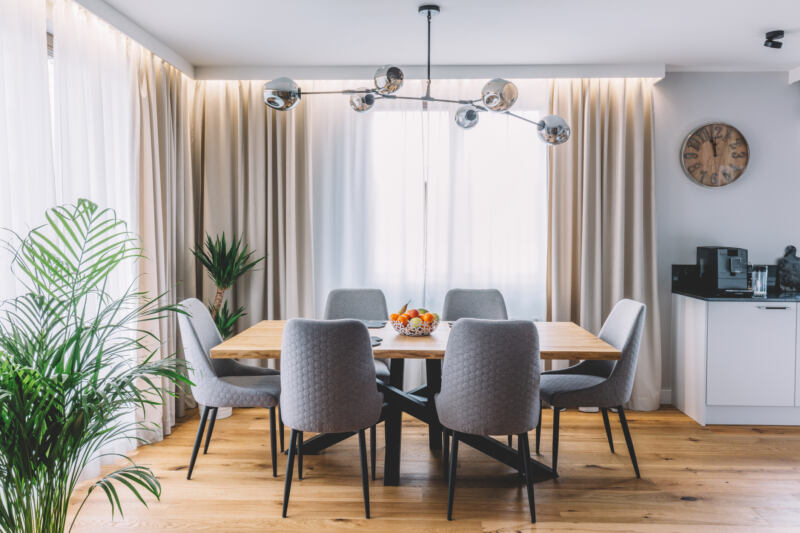
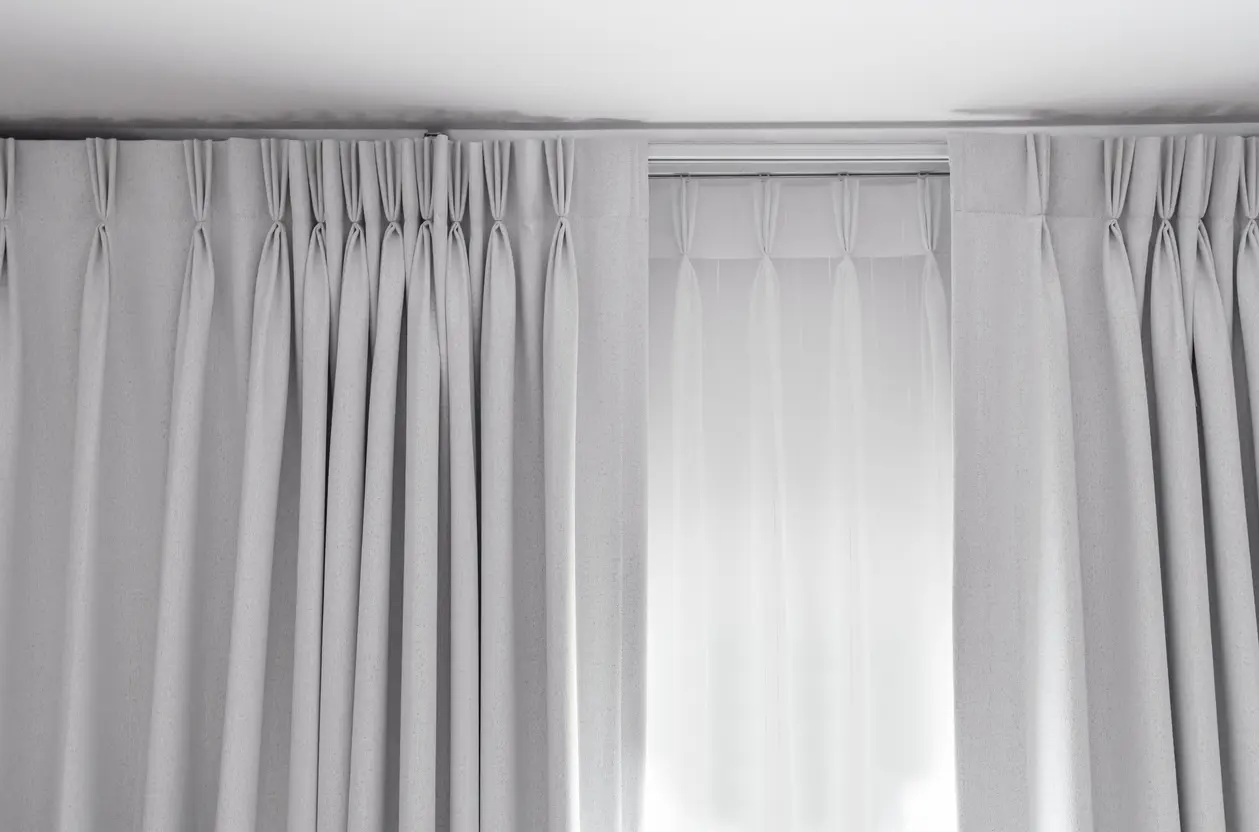
Tailored pleat curtains are made with structured folds sewn into the top of the fabric to create a neat, consistent and carefully finished heading. Rather than gathering loosely along a curtain pole or track, the fabric is divided into evenly spaced pleats that help the curtains hang in controlled vertical lines.
This type of heading is often chosen when a room needs a refined and considered window treatment. It can work in both traditional and contemporary interiors, depending on the fabric, pleat style and hardware selected.
Tailored pleats are particularly effective with full-length curtains because the structured heading encourages the fabric to fall in regular columns from the top of the window to the floor. They can frame the glazing elegantly, create a sense of height and give the curtains a more bespoke appearance.
The term can refer to several related styles, including single, double and triple pleats. Each creates a different degree of fullness and formality, but all share the same carefully shaped and stitched construction.
How are tailored pleat curtains constructed?
Tailored pleat curtains are made by forming sections of fabric into regular folds at the top of each curtain.
These folds are sewn into position rather than being created only by pulling a gathering cord. The pleats therefore remain structured whether the curtains are open or closed.
A typical construction process involves:
- Calculating the required finished curtain width
- Allowing sufficient additional fabric for fullness
- Dividing the heading into evenly spaced sections
- Folding and shaping each pleat
- Stitching the pleats securely
- Adding hooks in carefully measured positions
- Hanging the curtains from rings or a track
The accuracy of this process is important. Uneven spacing or inconsistent pleat sizes can affect the way the curtains hang and cause the folds to look irregular.
Made-to-measure production allows the heading to be designed according to the exact width of the pole or track. This means the pleats, spaces and end returns can be balanced properly across the finished treatment.
What does the word tailored mean?
In curtain design, tailored describes a finish that is structured, precise and intentionally shaped.
A tailored pleat heading does not have the relaxed irregularity of a loosely gathered curtain. The pleats are measured and stitched so they repeat consistently along the top edge.
This creates a more controlled appearance that can make the window treatment feel integrated with the architecture of the room.
Tailored curtains often suit interiors where proportion, symmetry and clean detailing are important. However, the overall result does not need to feel overly formal.
A soft linen, wool blend or textured neutral fabric can make the heading feel warm and understated. A silk-effect or finely woven fabric can create a more polished and luxurious appearance.
What are the different types of tailored pleats?
Several pleat styles fall within the broader category of tailored curtains. The main difference is the number of folds formed within each individual pleat.
What is a single pleat?
A single pleat uses one folded section of fabric at each heading point.
It creates a simple, relatively slim profile and generally requires less fullness than double or triple pleats.
Single pleats can suit:
- Contemporary interiors
- Smaller windows
- Narrow spaces
- Heavier fabrics
- Rooms where a restrained heading is preferred
Because the pleats use less fabric, the curtain may create a smaller stack when open. This can help preserve more of the glazing and natural light.
The appearance is still structured, but it tends to feel lighter and less formal than a fuller pleat.
What is a double pleat?
A double pleat uses two folds within each grouped heading section.
This creates more body and decorative detail than a single pleat while remaining relatively streamlined.
Double pleats are highly versatile and can work in:
- Living rooms
- Dining rooms
- Bedrooms
- Traditional properties
- Modern interiors
- Formal or relaxed design schemes
They provide enough fullness to create attractive vertical folds without becoming excessively heavy.
For many rooms, a double pleat offers a balanced middle ground between a simple single fold and a more substantial triple pleat.
What is a triple pleat?
A triple pleat is formed from three folds grouped together at each heading point.
It creates a fuller, more decorative and more formal appearance. This style may also be known as a triple pinch pleat, although terminology can vary between curtain makers and suppliers.
Triple pleats are often used with:
- Tall windows
- Wide curtain treatments
- Full-length curtains
- Formal sitting rooms
- Principal bedrooms
- Period properties
- Luxurious or finely detailed fabrics
The increased fullness gives the curtain more visual substance. However, it also creates a larger fabric stack when the curtains are open.
The pole, track and surrounding wall space must therefore be planned carefully.
Are tailored pleats the same as pinch pleats?
Tailored pleats and pinch pleats are often used as closely related terms.
A pinch pleat heading is created by pinching and stitching the fabric into single, double or triple groups. This is a structured, tailored method of construction.
Some suppliers may use tailored pleat as a broader description, while others use it for a specific variation of a pinch pleat heading.
When ordering curtains, it is useful to confirm:
- The number of folds in each pleat
- The depth of the heading
- The amount of fullness
- How the hooks will be positioned
- Whether the pleats sit above or below the pole
- The intended appearance when open and closed
A physical sample or clear drawing can help avoid misunderstandings about the finished design.
How do tailored pleats differ from pencil pleats?
Pencil pleat curtains use gathering cords within a heading tape. When the cords are pulled, the fabric gathers into many narrow, repeated folds resembling a row of pencils.
This creates a softer and less fixed heading than tailored pleats.
The main differences include:
- Tailored pleats are sewn into defined groups
- Pencil pleats are created by gathering heading tape
- Tailored pleats have wider spaces between structured folds
- Pencil pleats create many smaller folds
- Tailored pleats usually look more bespoke
- Pencil pleats are often more adjustable
Pencil pleat curtains can be practical where the curtain width may need slight adjustment. They also work with both poles and tracks.
Tailored pleats are generally selected where the exact finished width is known and a more deliberate, refined appearance is wanted.
How do tailored pleats compare with eyelet curtains?
Eyelet curtains have metal rings set directly into the fabric at the top. The curtain pole passes through these rings, creating broad wave-like folds.
Eyelets tend to create a contemporary and informal appearance. They are simple to operate and place the pole prominently within the overall design.
Tailored pleats hang from hooks attached to rings or a track. This creates a more traditional curtain construction, although the finished look can still be modern.
Tailored pleats may be more suitable where:
- A precise heading is required
- The curtain pole should sit above the fabric
- A track will be used
- The room needs a more refined finish
- The curtain fabric is too delicate for large eyelets
Eyelet curtains may work better where simplicity and easy movement are the main priorities.
How do tailored pleats compare with wave curtains?
Wave curtains use a specialist track and heading system that creates smooth, evenly spaced curves.
They have a very clean and contemporary appearance, particularly when fitted from ceiling to floor.
Tailored pleats create more defined and decorative folds at the heading. They often feel more traditional or crafted, although fabric choice can make them highly contemporary.
Wave curtains generally create a consistent ripple across the full width. Tailored pleats create groups of structured folds separated by flatter sections.
The choice depends on whether the room needs soft continuous waves or a more detailed, shaped heading.
Which rooms suit tailored pleat curtains?
Tailored pleat curtains are versatile, but they are especially effective in rooms where the window treatment contributes significantly to the overall design.
Do tailored pleats work well in living rooms?
Living rooms are well suited to tailored pleat curtains because the structured heading can help frame a main window or glazed door.
Full-length curtains with double or triple pleats can add height, softness and visual balance to the room.
They can be designed to feel:
- Calm and understated
- Formal and elegant
- Warm and traditional
- Clean and contemporary
- Rich and layered
The result depends on the fabric, lining, colour and curtain pole or track.
A plain fabric with a subtle weave can create a refined background. A patterned fabric can turn the curtains into a stronger focal point.
In a smaller living room, a single or double pleat may be more proportionate than a large triple pleat.
Are tailored pleat curtains suitable for bedrooms?
Tailored pleats can create an elegant and restful bedroom finish.
They work particularly well with full-length lined curtains, which can soften the room and help control light and privacy.
In a principal bedroom, they may be combined with:
- Roman blinds
- Sheer blinds
- Voile curtains
- Blackout lining
- Interlining
- Decorative tiebacks
A layered treatment allows the curtains to provide evening privacy and softness, while a blind manages daytime light.
For a compact bedroom, the curtain stack should be considered carefully. Fuller pleats require more wall space at the sides of the window.
Can tailored pleats be used in dining rooms?
Dining rooms often benefit from the structured and polished appearance of tailored curtains.
The pleats can help establish a sense of occasion without making the room feel excessively formal.
A double pleat in a textured or gently patterned fabric can work well in a contemporary dining area. A triple pleat with interlining may suit a more traditional room.
Curtain length is particularly important. Full-length curtains generally create a more complete and balanced effect than curtains ending at the sill, unless furniture or radiators make a shorter design necessary.
Are tailored pleats suitable for bay windows?
Tailored pleat curtains can work very well in bay windows, but the pole or track system must be planned carefully.
The curtains need to move around the angles of the bay and stack without crowding the glass.
Possible systems include:
- Made-to-measure bay poles
- Passing-ring poles
- Bent metal tracks
- Separate tracks for each section
- Ceiling-mounted systems
The heading should be compatible with the chosen hardware.
A tailored pleat can make a bay window feel elegant and architectural, but accurate measuring is essential. Incorrect spacing may cause the curtains to sit unevenly at the corners.
Do tailored pleat curtains suit modern interiors?
Tailored pleats are sometimes associated with traditional interiors, but they can look highly contemporary.
A modern result can be created through:
- Plain fabrics
- Textured neutrals
- Reduced fullness
- Single or double pleats
- Slim metal poles
- Discreet tracks
- Floor-to-ceiling fitting
- Simple colour palettes
The structured heading can complement modern interiors because it creates order and repetition.
Avoiding overly decorative finials, trims and heavy patterns will help maintain a cleaner appearance.
What fabrics work best with tailored pleats?
Many curtain fabrics can be used, but the material should be able to hold the pleat shape and hang attractively.
The weight, drape and thickness all affect the final result.
Are linen fabrics suitable?
Linen and linen-blend fabrics work well where a natural, relaxed and textured appearance is wanted.
Pure linen may crease and move more visibly, which can create a softer and less formal result. A blended fabric may provide greater stability.
A double pleat can give linen enough structure while preserving its natural character.
Linen fabrics may suit:
- Living rooms
- Bedrooms
- Dining rooms
- Natural colour schemes
- Contemporary country interiors
Lining helps improve the body of the curtain and protects the face fabric from direct sunlight.
Do velvet curtains work with tailored pleats?
Velvet can create a rich and substantial tailored curtain.
Its weight and depth suit larger rooms, tall windows and formal settings. The structured pleat controls the fullness and helps the fabric fall in strong vertical folds.
However, velvet curtains can become heavy. The pole, track, brackets and wall fixings must be suitable for the total weight.
The pile direction should also be consistent across all curtain panels because it affects how light reflects from the fabric.
A single or double pleat may sometimes be more practical than a very full triple pleat when the material is particularly thick.
Can patterned fabric be used?
Tailored pleats can display patterned fabric beautifully, but the design must be positioned carefully.
The pattern may need to be matched:
- Across two curtains
- Between multiple windows
- At the centre opening
- Along the lower hem
- Within the pleats
- Across seams in wide curtains
A large pattern can become partially hidden inside a triple pleat. The curtain maker should consider which parts of the design will remain visible.
Smaller repeated patterns may be easier to distribute evenly, while stripes can emphasise the vertical drop of the curtains.
Made-to-measure construction allows greater control over pattern placement and symmetry.
Are lightweight fabrics suitable?
Lightweight fabrics can be used, but they may need lining or interlining to create sufficient body.
Without enough structure, the pleats may appear flat or the lower sections may not fall evenly.
A lightweight decorative fabric can be paired with:
- Standard lining
- Blackout lining
- Lightweight interlining
- A weighted hem
The correct construction will depend on the desired opacity, fullness and movement.
Very delicate sheer fabrics are often better suited to alternative headings unless they are supported by specialist techniques.
How much fabric do tailored pleats use?
Tailored pleat curtains require more fabric than the finished width of the window because the material is folded into the pleats.
The amount of additional fabric is known as fullness.
The required fullness depends on:
- Pleat type
- Fabric thickness
- Pattern repeat
- Pole or track width
- Desired stack size
- Overall design
Triple pleats usually require more fullness than single pleats.
Using too little fabric can make the curtains look flat and under-scaled. Using excessive fullness can create an unnecessarily bulky stack and place more weight on the hardware.
A bespoke specification balances visual richness with practical operation.
How do tailored pleats affect the way curtains stack?
When tailored curtains are opened, the pleats help organise the fabric into regular folds.
Fuller headings and thicker fabrics create a wider stack. This is the space occupied by the curtains at either side of the window.
The stack should ideally sit partly beyond the window frame so it does not block too much glass.
Before ordering, consider:
- Available wall space
- Nearby furniture
- Radiators
- Shelves
- Wall lights
- Adjacent windows
- The width of the pole or track
If space is limited, a less full heading or lighter fabric may be more suitable.
Can tailored pleats hang from a curtain pole?
Yes. Tailored pleat curtains commonly hang from rings fitted to a curtain pole.
Hooks are inserted into the back of the heading and attached to the rings. This allows the pleats to sit below the pole in a neat, repeated arrangement.
The pole should suit the scale of the curtains. A substantial double or triple pleat may look unbalanced on a very thin pole.
The spacing and number of rings must also be correct. Too few rings can cause the fabric between pleats to sag or pull unevenly.
Decorative poles work well where the hardware is intended to remain visible as part of the room design.
Can they be fitted to a track?
Tailored pleat curtains can also hang from a track.
A track may be preferable where:
- The curtains are wide or heavy
- Smooth movement is important
- The hardware should be discreet
- The curtains are ceiling mounted
- The window is bay-shaped
- A pelmet will conceal the heading
Tracks can be manual, cord-operated or motorised.
A concealed track creates a clean finish and can make the curtains appear to fall directly from the ceiling.
The hook positions should be set so the heading sits at the intended height and conceals the front of the track where required.
What linings can be used?
The lining affects light control, body, insulation and the way the curtains hang.
What does standard lining provide?
Standard lining adds weight and protects the face fabric from direct sunlight.
It can also improve privacy and create a cleaner appearance from outside the property.
For many living rooms and dining rooms, standard lining provides a suitable balance between performance and fabric movement.
When is blackout lining useful?
Blackout lining is often chosen for bedrooms, nurseries and media rooms.
It reduces light passing through the fabric, although some light may still enter around the sides or above the curtains.
The lining can make the curtains feel slightly firmer and more substantial.
The term blackout refers to the lining material rather than a guarantee of complete darkness across the entire window.
What is interlining?
Interlining is an additional layer placed between the face fabric and the outer lining.
It adds body, softness and insulation, helping curtains look fuller and more luxurious.
Interlining can be particularly effective with tailored pleats because it gives the folds greater substance.
It may be chosen for:
- Formal living rooms
- Principal bedrooms
- Draughty windows
- Fine decorative fabrics
- Period properties
- Rooms requiring a fuller finish
Interlined curtains are heavier and require suitable poles, tracks and fixings.
Are tailored pleat curtains easy to operate?
Well-made tailored curtains should open and close smoothly when fitted to suitable hardware.
The structured heading helps guide the fabric into regular folds. However, very full or heavy curtains may require more effort to move manually.
For wide windows, motorised tracks can improve convenience and protect the fabric from repeated handling.
Hand-drawn curtains may develop marks if users regularly pull the face fabric. A curtain wand can allow the treatment to be operated without touching the main material.
The pole or track should be kept clean and properly maintained so rings or gliders move freely.
Are tailored pleat curtains difficult to clean?
Cleaning depends on the fabric, lining and construction.
Many bespoke tailored curtains are not suitable for ordinary machine washing. The pleats, lining and interlining may lose their shape if cleaned incorrectly.
Routine care may include:
- Gentle vacuuming with a soft attachment
- Keeping curtains away from damp surfaces
- Avoiding direct handling with dirty hands
- Addressing small marks promptly
- Using professional curtain cleaning when necessary
The care instructions for the specific face fabric and lining should always be followed.
Curtains should be removed and rehung carefully to preserve the pleat spacing and hook positions.
What should you consider before ordering tailored pleat curtains?
A successful treatment requires several decisions to be made together.
Which pleat style suits the room?
Single pleats feel simpler, double pleats offer balanced fullness and triple pleats create a more decorative finish.
How much space is available?
Consider both the wall space around the window and the curtain stack when open.
Which fabric has the right weight and drape?
The fabric should support the chosen pleat while relating to the room’s furniture, flooring and colour scheme.
What lining is required?
Consider privacy, light control, insulation and the desired level of fullness.
Will the curtains hang from a pole or track?
The hardware must suit the heading, curtain weight and architectural conditions.
What finished length is appropriate?
Full-length curtains often create the strongest tailored effect. The lower edge may finish just above the floor, touch it lightly or break more generously.
How will the curtains be operated?
Manual, corded and motorised options should be considered according to the width, weight and accessibility of the window.
Frequently Asked Questions
Are tailored pleat curtains old-fashioned?
No. Tailored pleats can work in traditional or contemporary interiors. Fabric, fullness, hardware and fitting height determine the overall style.
Which is better, double or triple pleat curtains?
Neither is universally better. Double pleats provide balanced fullness and versatility, while triple pleats create a fuller and more formal appearance.
Can tailored pleats be used on short curtains?
Yes, although they are often most effective on full-length curtains. Short curtains need careful proportions so the heading does not appear too heavy for the drop.
Do tailored pleat curtains need special hooks?
They use curtain hooks positioned within the structured heading. The type and placement depend on whether the curtains hang from a pole or track.
Are tailored pleat curtains more expensive?
They may cost more than simple taped headings because they require precise measuring, additional construction and often more fabric. The final price also depends on the material, lining, size and hardware.
Are tailored pleat curtains right for your room?
Tailored pleat curtains are ideal when you want a structured, elegant and carefully proportioned window treatment.
Their sewn heading creates regular folds that help the fabric hang neatly from top to bottom. Single, double and triple pleat options allow the level of fullness to be adjusted according to the scale and style of the room.
They work particularly well in living rooms, bedrooms, dining areas and bay windows, and they can be adapted to both traditional and contemporary interiors.
The most successful result comes from choosing the pleat style, fabric, lining, pole or track as one complete design. Accurate measuring and skilled construction help ensure the curtains stack properly, move smoothly and relate naturally to the window.
For advice on selecting fabrics, pleat styles and made-to-measure tailored curtains for your home, contact Zenn Interiors for a personalised consultation.
Phone: 020 7871 3082
Email: zenninteriors@gmail.com
Find out more: https://zenninteriors.co.uk/