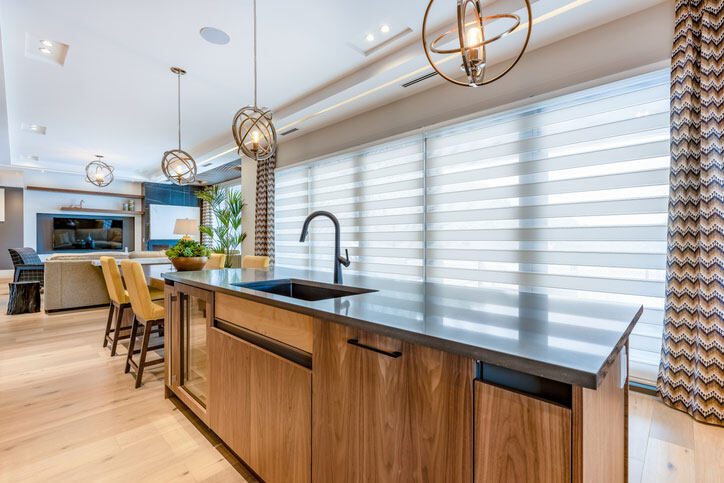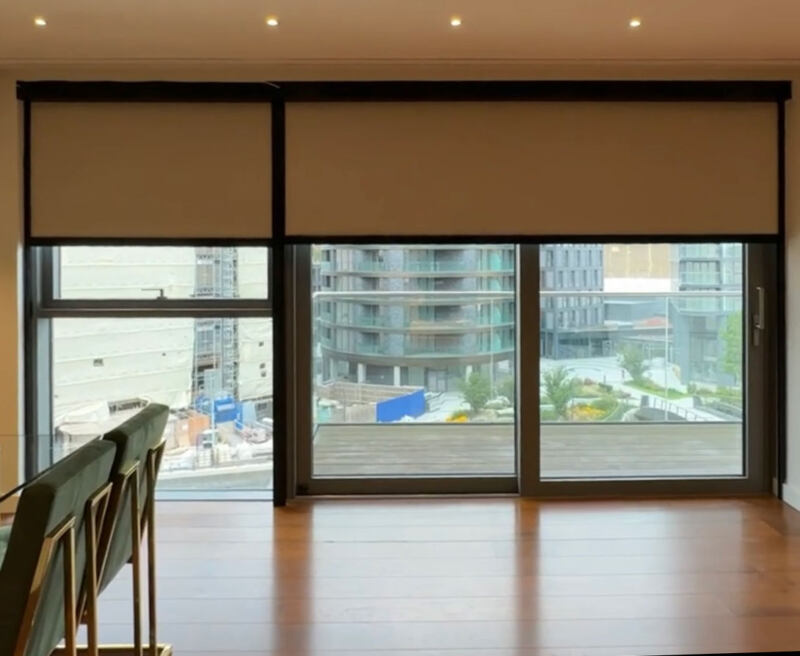
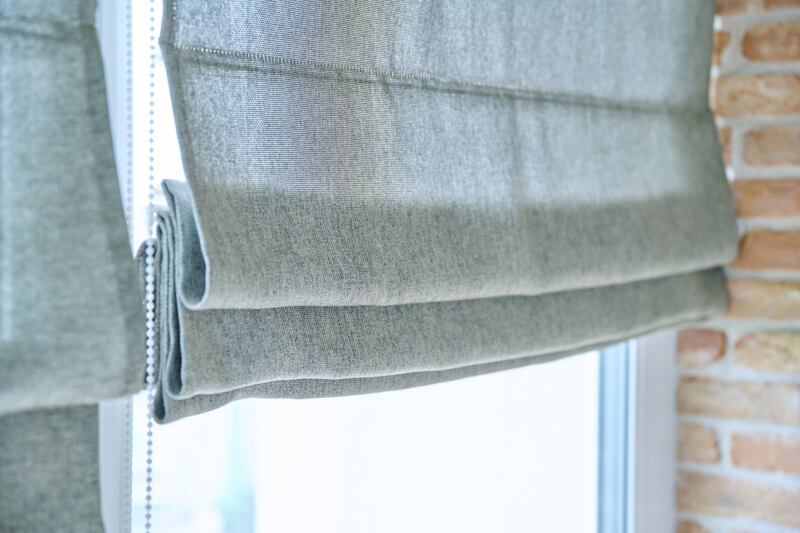
Roman blinds and curtains both bring fabric, softness and colour to a room, but they work in very different ways. Roman blinds fold upwards into neat horizontal sections, while curtains draw to either side of the window and usually extend beyond the frame.
The best choice depends on the size of the room, the shape of the window, the amount of available wall space and the type of atmosphere you want to create. Roman blinds tend to produce a tailored, compact finish, while curtains can create a softer, fuller and more traditional appearance.
Neither option is automatically better. A well-designed interior may use Roman blinds in one room, curtains in another and a combination of both where extra softness, insulation or privacy is needed.
Understanding how the two treatments differ will help you choose an option that works both visually and practically.
What is the main difference between Roman blinds and curtains?
The most obvious difference is how each treatment opens and closes.
A Roman blind is made from a flat panel of fabric that lifts upwards using cords or a motorised mechanism. As it rises, the fabric forms a series of horizontal folds near the top of the window.
Curtains hang vertically from a pole or track and move sideways. When open, they gather at one or both sides of the window. When closed, they cover the glazing with hanging folds of fabric.
This difference affects how much space each option occupies.
A Roman blind generally stays within or directly around the window area. Curtains require additional room to either side so the fabric can stack back without blocking too much glass.
Roman blinds can therefore be useful where:
- Wall space is limited
- Furniture sits close to the window
- There is a radiator below the sill
- A clean and contained finish is preferred
- The room would feel crowded with full-length fabric
Curtains may be more suitable where:
- There is enough wall space for generous fabric
- A softer or more luxurious effect is wanted
- The room has tall ceilings
- The window needs to appear wider or taller
- Additional insulation and layering are important
The choice is not simply between a blind and a curtain. It is also a decision about scale, proportion and the visual role of the window within the room.
How do Roman blinds and curtains differ in appearance?
Roman blinds create a structured and tailored look. When lowered, the fabric forms a relatively flat panel, which allows a pattern or texture to be seen clearly. When raised, the folds create a decorative stack at the top of the window.
This can suit interiors that combine softness with clean lines. Roman blinds work well in contemporary, classic and transitional spaces because the final appearance depends heavily on the fabric.
Curtains create more movement and volume. Their vertical folds can soften the hard edges of windows, add height and make a room feel more complete.
The heading style has a major influence on the finished result. Tailored pleats create a more formal appearance, while softer gathered headings can feel relaxed and informal.
Curtains can also create a stronger sense of luxury because they use more fabric and occupy a larger visual area. Floor-length curtains may make a window appear more generous, even when the glazing itself is relatively modest.
Which option works best with patterned fabric?
Roman blinds display patterned fabric particularly well because the material appears as a broad, flat panel when closed.
This can be useful for:
- Large botanical designs
- Geometric patterns
- Decorative prints
- Stripes
- Textured weaves
However, the pattern will become partially hidden within the folds when the blind is raised.
Curtains also work well with patterns, but the vertical folds can distort or break up the design. This is not necessarily a disadvantage. A pattern may appear softer and less dominant when distributed across flowing fabric.
For either treatment, pattern placement should be considered during production. A made-to-measure finish allows the design to be positioned carefully and matched across multiple windows where necessary.
Which provides better light control?
Both Roman blinds and curtains can control light effectively, but they do so in different ways.
A Roman blind can be lowered to any height. This allows the upper or lower section of the window to remain exposed depending on the position of the blind.
However, a standard Roman blind does not provide directional light control in the way that a Venetian blind does. The fabric forms one continuous panel, so it cannot tilt to redirect sunlight.
Curtains can be partially drawn from the sides, allowing the centre of the window to remain open. This may be useful where sunlight enters from one side or where privacy is only needed across part of the glazing.
The amount of light blocked depends mainly on the lining and fabric.
Options may include:
- Unlined decorative fabric
- Standard lining
- Blackout lining
- Thermal lining
- Interlining for added body
A blackout-lined Roman blind can reduce a significant amount of light, but small gaps may remain around the edges. Curtains can cover a wider area beyond the window frame, which may reduce light leakage more effectively when designed with generous overlap.
For bedrooms, the fitting details matter as much as the fabric. A blind fitted inside the recess may leave visible side gaps, while curtains fitted beyond the frame can provide broader coverage.
Are Roman blinds or curtains better for privacy?
Both treatments can provide strong privacy when closed.
A Roman blind creates a continuous fabric panel across the window. This can be especially useful in ground-floor rooms, bedrooms and spaces facing neighbouring properties.
Curtains can also provide full privacy, but their effectiveness depends on how completely the fabric meets in the centre and whether there are gaps at the sides.
Roman blinds are often easier to adjust during the day. They can be lowered partway to screen the most exposed section of the window while leaving some natural light.
Curtains can be drawn slightly, although this may block more of the view and reduce daylight from the sides.
Privacy also depends on the fabric density. A lightweight, unlined material may become more transparent after dark when the interior lights are on.
For rooms where privacy is essential, a lining should be selected carefully rather than assuming that every decorative fabric will provide sufficient coverage.
Which option is better for insulation?
Curtains often provide greater insulation because they can cover the full height and width of the window, particularly when they are lined and fitted beyond the frame.
Heavy curtains can help reduce draughts and create an additional layer between the room and the glazing. Interlined curtains may provide even more body and thermal performance.
Roman blinds also offer some insulation, especially when made with a suitable lining. The fabric sits close to the window, helping to create a barrier over the glass.
However, the compact dimensions of a Roman blind usually mean it does not cover as much surrounding wall area as curtains.
The insulating performance of either treatment depends on:
- Fabric weight
- Lining type
- Fit around the window
- Gaps at the sides
- Window condition
- Whether the treatment reaches the floor or sill
For a particularly cold room, combining a Roman blind with curtains can provide additional layers. The blind sits close to the glazing, while the curtains extend over the full opening.
This layered arrangement can also improve acoustic softness and create a more finished appearance.
Are Roman blinds more practical in small rooms?
Roman blinds are often a strong choice in compact rooms because they use less space around the window.
Curtains may project into the room, cover part of a radiator or interfere with furniture. They also require enough width for the fabric to stack back.
A Roman blind can usually be fitted inside the recess or neatly above it. This keeps the walls clear and makes the window area feel more contained.
They are particularly useful in:
- Small bedrooms
- Home offices
- Dining alcoves
- Narrow hallways
- Box rooms
- Window seats
- Kitchens with nearby worktops
However, a Roman blind still creates a fabric stack at the top when raised. This can cover part of the glass, especially on a shallow window.
The blind should therefore be positioned carefully. Fitting it above the recess may allow more of the window to remain visible when the blind is open.
Which rooms are best suited to Roman blinds?
Roman blinds work particularly well where softness is desired but full curtains would be impractical or visually overwhelming.
Do Roman blinds work well in bedrooms?
Roman blinds can create a calm, tailored bedroom finish. They are especially effective above a dressing table, radiator or piece of furniture where full-length curtains would be inconvenient.
A blackout lining can help reduce incoming light, while a thermal or interlined construction may add comfort.
For a principal bedroom, a Roman blind can also be paired with curtains to create a more layered and luxurious effect.
The blind may provide everyday light control, while the curtains add decorative fullness and can be drawn at night for greater privacy.
Are Roman blinds suitable for living rooms?
Roman blinds can suit both formal and relaxed living rooms.
A textured neutral fabric may blend quietly with the walls, while a patterned blind can become a feature within the room.
They are especially useful in bay windows, although each section must be measured carefully to ensure the blinds do not interfere with one another.
A Roman blind can also work well where the window sits behind a sofa or sideboard, as it does not require floor space.
In a larger living room, curtains may create a more balanced sense of scale. A small blind on a wide wall can look underwhelming if the proportions are not considered.
Can Roman blinds be used in kitchens?
Roman blinds can be used in kitchens, particularly in dining areas or at windows positioned away from cooking and washing zones.
Fabric should not be exposed to regular grease, steam or splashes. Unlike some roller blind materials, Roman blinds are not usually designed to be wiped clean frequently.
The folds can also collect dust and residue, so placement is important.
A Roman blind may be suitable for:
- A breakfast area
- A kitchen-diner
- A window away from the hob
- A room with good ventilation
- A decorative window that needs softness
For a window directly behind a sink or close to a hob, a more moisture-resistant and easier-to-clean blind may be more practical.
Which rooms are best suited to curtains?
Curtains are particularly effective in rooms where softness, height and visual impact are important.
Why are curtains popular in living rooms?
Living rooms often benefit from the scale and warmth of curtains. Full-length fabric can frame a window, soften hard surfaces and create a sense of comfort.
Curtains may also help balance large furniture pieces and create a more complete composition across a wide wall.
Where the room has high ceilings, mounting the curtain pole or track above the window can emphasise height and make the glazing appear more generous.
Curtains also provide flexibility through fabric volume, heading style and lining. They can be tailored to look formal, relaxed or understated.
Are curtains better for large windows?
Curtains can be particularly effective across wide windows, patio doors and large glazed openings.
A Roman blind for a very wide window may become heavy and difficult to operate. Multiple blinds may be required, which creates visible divisions.
Curtains can cover the full opening with fewer interruptions. They may also stack beyond the glass, preserving more of the view when open.
However, sufficient space is required at the sides. If the curtains cannot stack back properly, they may block a significant portion of the window.
A track system may be preferable for wide openings because it can support smooth movement and larger volumes of fabric.
How do the costs compare?
The cost of Roman blinds and curtains depends on the fabric, size, lining, hardware and level of craftsmanship.
Roman blinds may use less fabric than curtains, but they require a structured internal system, accurate construction and a suitable mechanism.
Curtains use more material, particularly when they are full length and designed with generous fullness. They also require a pole or track and may include additional costs for tiebacks, decorative finials or specialist headings.
Factors that affect the price include:
- Width and drop
- Fabric price per metre
- Pattern repeat
- Lining or interlining
- Hand-finished details
- Bespoke hardware
- Motorised operation
- Installation requirements
A straightforward Roman blind is not always cheaper than a simple pair of curtains. The final cost should be assessed according to the full specification rather than the product category alone.
Which is easier to clean and maintain?
Both options require appropriate care, but curtains may be easier to remove for specialist cleaning.
Roman blinds contain rods, cords, a headrail and sometimes interlining. They are not always designed for frequent removal, and cleaning methods depend on the fabric and construction.
Routine care may involve gentle vacuuming with a soft upholstery attachment.
Curtains can also be vacuumed, but some fabrics may be dry-cleaned after removal. Large, lined or interlined curtains can be heavy, so taking them down and rehanging them may require professional help.
Neither treatment should be assumed to be machine washable unless the fabric and construction are specifically designed for it.
The most practical option depends on the room. In a low-traffic bedroom, either treatment may remain clean for long periods. In a kitchen or busy family space, a simpler blind material may be easier to maintain than either Roman blinds or full curtains.
How do Roman blinds and curtains affect the proportions of a room?
Window treatments can change how a room feels.
Roman blinds tend to emphasise the width and shape of the window itself. They create a compact visual block and do not usually extend far beyond the frame.
Curtains can alter the apparent scale of the window. Fitting them higher and wider than the opening can make the window look taller and broader.
This can be useful in a room with low ceilings or narrow glazing.
Full-length curtains also create strong vertical lines, which can draw the eye upwards. Roman blinds create horizontal folds, which may make a window feel wider or more grounded.
The proportions of the wall should be considered before choosing. A large expanse of wall around a small Roman blind may feel bare, while very full curtains in a narrow room may overwhelm the available space.
Can Roman blinds and curtains be used together?
Roman blinds and curtains can work extremely well together when each has a clear purpose.
The Roman blind may provide:
- Daytime light control
- Privacy
- A decorative focal point
- Coverage close to the glass
The curtains may provide:
- Additional insulation
- Greater evening privacy
- Softness and volume
- Height and visual framing
This combination is especially effective in bedrooms, living rooms and formal dining rooms.
The fabrics do not need to match exactly. A patterned Roman blind can be paired with plain curtains in a coordinating colour, or a neutral blind can sit behind more decorative curtain fabric.
Care should be taken to avoid creating too much visual weight. If both treatments are highly patterned, heavily textured or strongly coloured, the window may dominate the entire room.
A restrained approach often creates a more refined result.
What should you consider before deciding?
The right choice should be based on the room, the window and how the treatment will be used.
How much wall space is available?
Curtains require space at the sides and above the window. Roman blinds are generally more compact.
Is there furniture near the window?
A desk, radiator, sofa or window seat may make a Roman blind more practical.
How important is insulation?
Full-length, lined curtains often provide greater coverage. Combining curtains with a blind can add further layers.
How much natural light do you want to preserve?
A Roman blind creates a stack at the top of the window. Curtains may block light at the sides if they cannot stack beyond the opening.
What style suits the room?
Roman blinds provide a neat and tailored finish. Curtains create greater softness, movement and scale.
How often will the treatment be adjusted?
A well-made Roman blind is easy to raise and lower, while curtains may be quicker to draw across a large opening.
Frequently Asked Questions
Are Roman blinds more modern than curtains?
Roman blinds often create a cleaner and more compact appearance, but they are not limited to modern interiors. Fabric choice, pattern and detailing can make them suitable for traditional, classic or contemporary rooms.
Do Roman blinds use less fabric than curtains?
They usually use less fabric because they cover the window as a flat panel. Curtains require additional fullness to create folds and may extend beyond the window frame.
Are curtains warmer than Roman blinds?
Lined, floor-length curtains can provide greater coverage and may offer better insulation. Roman blinds still add a fabric layer over the glass, particularly when lined or interlined.
Can Roman blinds be blackout lined?
Yes. Blackout lining can reduce light passing through the blind, although some light may still enter around the edges.
Are Roman blinds suitable for wide windows?
They can be made for many wide windows, but larger blinds become heavier and may require a stronger mechanism. Multiple blinds or curtains may be more practical for particularly wide openings.
Choosing between Roman blinds and curtains
Roman blinds are ideal when you want a tailored fabric finish without using much space around the window. They suit smaller rooms, windows above furniture and interiors where clean lines are important.
Curtains are often better where the room needs softness, scale and stronger visual framing. They can cover large openings, improve insulation and make windows appear taller or wider.
The most effective choice depends on proportion, practicality and the atmosphere you want to create. In some rooms, combining Roman blinds and curtains provides the best balance of light control, privacy, comfort and decorative impact.
For advice on choosing made-to-measure Roman blinds, curtains or a coordinated combination for your home, contact Zenn Interiors for a personalised consultation.
Phone: 020 7871 3082
Email: zenninteriors@gmail.com
Find out more: https://zenninteriors.co.uk/