
Choosing curtains involves more than finding a fabric you like. Different curtain styles offer different levels of privacy, light control, insulation and decorative appeal.
The main types of curtains include sheer, lined, blackout and interlined curtains, while popular heading styles include pencil pleat, pinch pleat, wave, eyelet and tab top.
Understanding the difference between curtain construction and heading style makes it easier to choose the right window treatment for your home.
For example, you might choose blackout curtains with a pencil pleat heading for a bedroom, or lightweight sheer curtains with a wave heading for a contemporary living room.
In this guide, we’ll explain the different types of curtains, how they work, which rooms they’re suited to and what you should consider before choosing.
What Are the Different Types of Curtains?
Curtains can be classified in several ways.
Some terms describe the materials and layers used to make them, while others describe their appearance or the way they attach to a curtain pole or track.
| Category | Examples | What it affects |
|---|---|---|
| Curtain construction | Sheer, lined, blackout, interlined | Privacy, light control, insulation and appearance |
| Curtain heading | Pencil pleat, pinch pleat, wave, eyelet, tab top | Fold shape, fitting method and overall style |
| Fabric | Velvet, linen, cotton, silk blends | Texture, drape, maintenance and colour |
| Accessories | Poles, tracks, pelmets, valances | Installation, operation and decorative finish |
These categories can overlap.
A set of curtains might combine a velvet face fabric, blackout lining, triple pinch pleat heading and decorative metal pole.
The important thing is to choose components that work together.

Types of Curtains by Construction and Function
The most useful starting point is deciding what you need your curtains to do.
Do you want to soften daylight, improve privacy, reduce unwanted light or add warmth and fullness to the room?
1. Sheer Curtains
Sheer curtains are made from lightweight, translucent fabric that allows daylight to pass through.
They’re particularly useful when you want to soften bright sunlight without covering the window with an opaque material.
Common sheer fabrics include voile and lightweight woven materials.
Benefits of Sheer Curtains
- Allow natural light into the room.
- Soften harsh sunlight and reduce some glare.
- Create a light, relaxed appearance.
- Provide varying degrees of daytime privacy.
- Work well as part of a layered window treatment.
Are Sheer Curtains Private at Night?
Sheer curtains can make it harder to see into a room during the day, particularly when the exterior is brighter than the interior.
However, they do not guarantee privacy at night.
When indoor lights are on and it’s dark outside, people may be able to see through the fabric.
For greater evening privacy, consider layering sheer curtains with lined or blackout curtains.
Best for: Living rooms, dining rooms, large windows and spaces where maintaining daylight is important.
Explore Zenn Interiors’ made-to-measure sheer curtains.
2. Lined Curtains
Lined curtains have a separate layer of material attached behind the decorative face fabric.
The lining helps provide a more finished appearance and can improve opacity and fabric drape.
It may also help protect the face fabric from some of the effects of sunlight.
Benefits of Lined Curtains
- Provide additional privacy compared with many unlined fabrics.
- Improve the body and drape of the curtain.
- Reduce the amount of light passing through the fabric.
- Create a more substantial appearance.
- Can contribute to improved comfort at windows.
Standard lining doesn’t necessarily make a curtain blackout.
The amount of light blocked depends on the face fabric, lining specification and overall construction.
Best for: Living rooms, bedrooms and other spaces where you want a balance of decorative appeal and practical coverage.
Discover Zenn Interiors’ lined curtains.
3. Blackout Curtains
Blackout curtains use specially designed fabric or lining to block most or all light passing directly through the curtain material.
They’re particularly popular in bedrooms, nurseries and rooms where controlling daylight is important.
Benefits of Blackout Curtains
- Reduce unwanted daylight.
- Provide strong privacy when closed.
- Can make bedrooms more comfortable for daytime sleeping.
- May help reduce solar heat entering a room when closed during strong sunlight.
- Work with several curtain heading styles.
Do Blackout Curtains Make a Room Completely Dark?
Not necessarily.
Even if the fabric itself is highly effective at blocking light, daylight can still enter around the top, sides, bottom or centre opening of the curtains.
For better room darkening, consider the installation position, curtain overlap and fitting system alongside the material.
Best for: Bedrooms, nurseries, television rooms and rooms exposed to bright sunlight.
Explore Zenn Interiors’ blackout curtains.
4. Interlined Curtains
Interlined curtains include an additional soft layer between the decorative fabric and the lining.
This extra layer gives the curtains greater body and can improve their insulating properties.
Interlining is often used in traditional and premium made-to-measure curtains where fullness and an elegant drape are priorities.
Benefits of Interlined Curtains
- Create a fuller, more substantial curtain.
- Add softness and structure to the finished fabric.
- Provide an additional insulating layer at the window.
- Complement traditional and luxurious interiors.
- Can help improve comfort near cold glazing.
Interlined curtains are generally heavier and bulkier than comparable curtains without interlining.
The pole or track must therefore be suitable for the finished curtain weight.
Interlining can also help soften some sounds within a room, but it shouldn’t be confused with complete soundproofing.
Best for: Period properties, formal sitting rooms, bedrooms and interiors where a rich, full curtain appearance is desired.
Explore Zenn Interiors’ interlined curtains.
Which Type of Curtain Is Best for Light Control and Privacy?
The following comparison can help you narrow down your options.
| Curtain type | Daylight control | Privacy | Typical appearance |
|---|---|---|---|
| Sheer | Filters and softens daylight | Limited, especially at night | Light and airy |
| Standard lined | Reduces light passing through fabric | Generally good when closed | Structured and versatile |
| Blackout | Strong light reduction | Strong when properly closed | Depends on face fabric |
| Interlined | Depends on face fabric and lining | Depends on construction | Full and substantial |
A curtain’s actual performance also depends on its fit and installation.
For example, a blackout curtain with large gaps around the window may allow more daylight into a bedroom than expected.
Different Curtain Heading Styles
Once you’ve decided which type of curtain construction you need, the next step is choosing how the curtain should hang.
The heading is the finished top section that determines how the fabric gathers, folds and attaches to the hardware.
The styles below include both headings offered by Zenn Interiors and other commonly used designs.
5. Pencil Pleat Curtains
Pencil pleat curtains have a gathered heading created using adjustable heading tape.
When the cords are pulled, the fabric forms narrow folds resembling pencils.
They’re popular because of their versatility and traditional appearance.
Key characteristics:
- Soft, gathered folds.
- Suitable for many conventional curtain poles and tracks.
- Can be used with different curtain fabrics and linings.
- Adaptable to traditional and contemporary interiors.
Pencil pleats are often a practical choice for bedrooms and living rooms.
Discover Zenn Interiors’ pencil pleat curtains.
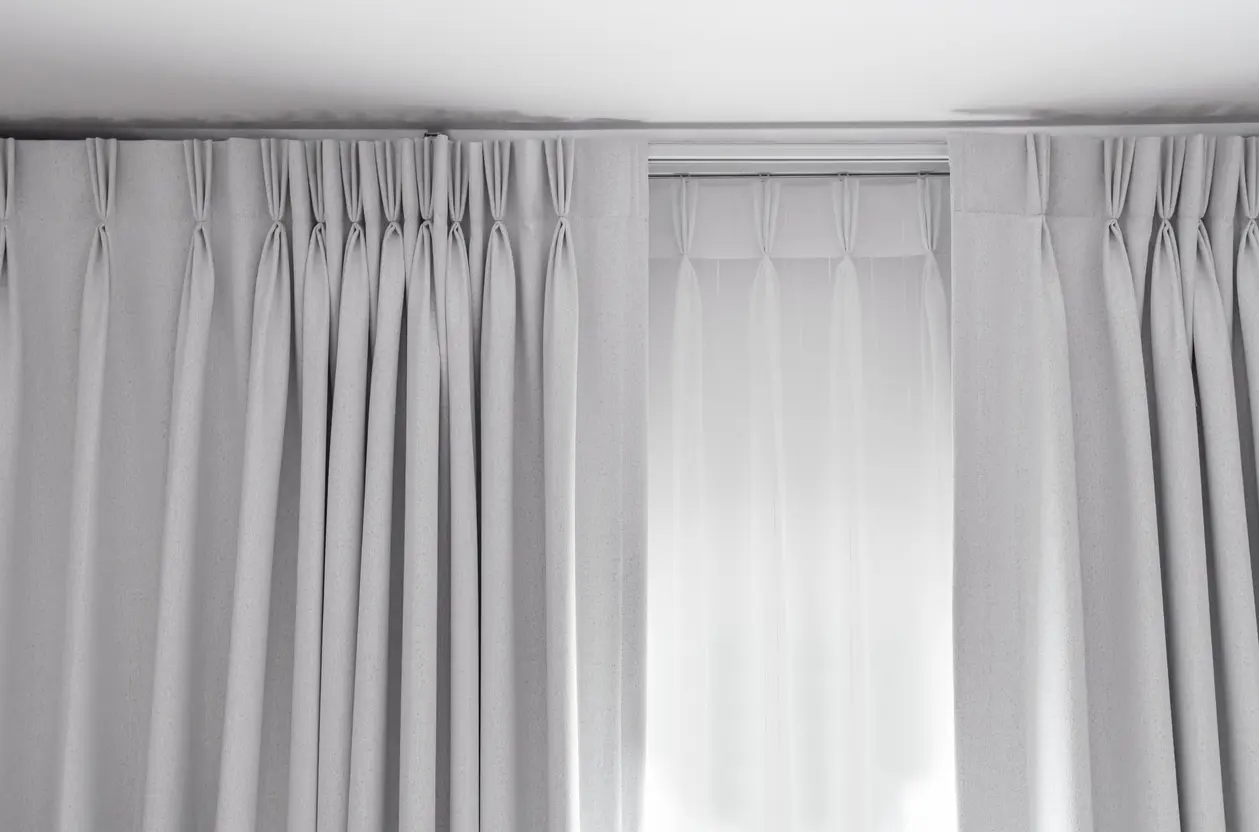
6. Pinch Pleat Curtains
Pinch pleat curtains feature groups of folds stitched together at the top.
Unlike pencil pleats, these folds are permanently formed during manufacture.
Two popular variations are double and triple pinch pleats.
Double Pinch Pleats
Double pinch pleats use groups of two folds to create a structured, tailored appearance.
They can provide a smart finish without looking overly elaborate.
Triple Pinch Pleats
Triple pinch pleats use groups of three folds and generally create a fuller, more formal appearance.
They’re particularly suited to luxurious fabrics and traditional interiors.
Key characteristics:
- Permanently structured folds.
- Elegant, tailored appearance.
- Compatible with suitable poles or tracks.
- Often used for full-length curtains.
Discover Zenn Interiors’ pinch pleat curtains.
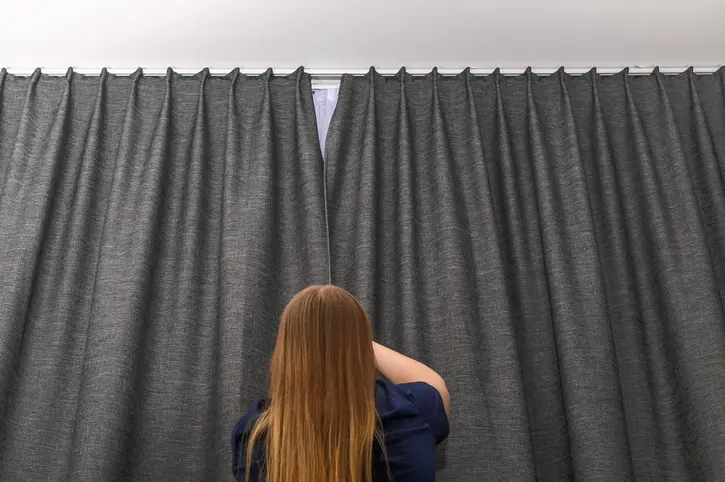
7. Wave Curtains
Wave curtains create smooth, continuous folds that form a regular S-shaped pattern.
Their appearance is maintained by a specialist track or compatible pole system with coordinated carriers.
They’re particularly popular in contemporary interiors because of their clean, understated look.
Key characteristics:
- Consistent, flowing folds.
- Suitable for many wide-window arrangements.
- Contemporary appearance.
- Requires compatible wave hardware.
Wave curtains can work particularly well with floor-to-ceiling glazing and large living-room windows.
Explore Zenn Interiors’ wave pleat curtains.
8. Eyelet Curtains
Eyelet curtains have reinforced rings fitted into the top of the fabric.
The curtain pole passes directly through these openings, producing broad, regular folds.
They don’t normally use conventional curtain hooks.
Key characteristics:
- Modern, simple appearance.
- Designed for compatible curtain poles.
- Visible eyelets form part of the design.
- No separate rings or hooks are generally required.
Eyelet curtains are commonly used in contemporary bedrooms and living rooms.
However, they’re not usually suitable for standard curtain tracks.
Eyelet curtains are included here as a general heading style, not as a specifically advertised Zenn Interiors product.
9. Tab Top Curtains
Tab top curtains have fabric loops sewn along the top.
These loops are threaded directly onto a curtain pole.
The exposed fabric tabs create a casual, relaxed appearance.
Key characteristics:
- Informal decorative style.
- Suitable for compatible poles.
- Usually doesn’t require curtain hooks.
- Often used with lighter fabrics.
Tab top curtains can be attractive in relaxed interiors.
However, the fabric loops may create friction along the pole, making them less convenient for curtains that need to be opened and closed frequently.
10. Slot Top or Rod Pocket Curtains
Slot top curtains, also called rod pocket or cased heading curtains, have a sewn channel along the top.
The pole passes through this fabric pocket, so separate curtain rings or hooks aren’t usually required.
Key characteristics:
- Simple appearance.
- Often suitable for lightweight decorative curtains.
- Conceals much of the pole.
- Can be less convenient for frequent opening and closing.
Slot top curtains aren’t inherently more likely to break because they lack hooks.
Their practical limitation is that fabric moving directly against a pole can create friction, particularly with heavier materials or longer spans.
For curtains that are opened frequently, a ring or track-based system may provide easier movement.
11. Box Pleat Curtains
Box pleat curtains have folds arranged to create a flat, structured front with fabric folding back on either side.
The heading creates a regular, geometric appearance.
Key characteristics:
- Neat, architectural design.
- Structured folds.
- Suitable for selected formal or contemporary interiors.
- Requires careful construction for consistent spacing.
Box pleats can be effective where you want a defined, tailored curtain heading.
The finished appearance depends on pleat proportions, fabric weight and how the curtain is constructed.
12. Goblet Pleat Curtains
Goblet pleat curtains feature rounded, cup-shaped folds at the top of the fabric.
The shape resembles the bowl of a wine glass, which gives the heading its name.
Goblet pleats are associated with decorative and formal interiors.
Key characteristics:
- Distinctive rounded pleats.
- Traditional, luxurious appearance.
- Often used for decorative full-length curtains.
- Require structured construction to maintain their shape.
Goblet pleats may be less practical for certain frequently operated curtains, depending on the heading construction and hanging system.
They remain an option worth understanding when comparing traditional curtain designs.
13. Cartridge Pleat Curtains
Cartridge pleat curtains have rounded, cylindrical folds positioned at regular intervals.
They combine structured construction with a relatively clean, contemporary appearance.
Key characteristics:
- Rounded, evenly spaced folds.
- Architectural appearance.
- Suitable for both contemporary and traditional schemes.
- Highlights the texture and body of suitable fabrics.
Zenn Interiors offers cartridge pleat curtains as part of its made-to-measure collection.
14. Tailored Pleat Curtains
Tailored pleat curtains have neatly constructed folds designed to create a controlled, refined appearance.
The term refers to a particular style of heading rather than simply describing any curtain made by a tailor.
Key characteristics:
- Clean, structured finish.
- Understated decorative appearance.
- Carefully positioned folds.
- Suitable for elegant contemporary and traditional interiors.
Explore Zenn Interiors’ tailored pleat curtains.
For a more detailed comparison of heading styles, read our guide to seven popular curtain headings.
Different Curtain Fabrics
The fabric affects how curtains drape, feel and perform.
Two curtains with the same heading can look very different when made from different materials.
Velvet Curtains
Velvet creates a soft, rich appearance with depth of colour.
It’s particularly effective for traditional interiors and design schemes where texture is important.
Different velvets vary in weight and care requirements.
Linen and Linen-Blend Curtains
Linen creates a natural, relaxed appearance.
Linen blends may offer different draping and maintenance characteristics.
These fabrics work well in contemporary interiors and understated decorative schemes.
Cotton and Cotton-Blend Curtains
Cotton is available in many colours, weaves and patterns.
It can be used for casual or formal curtains depending on the fabric construction and finish.
Silk and Silk-Blend Curtains
Silk can provide a distinctive sheen and an elegant appearance.
However, prolonged sunlight can affect some silk fabrics, so appropriate lining and care should be considered.
Synthetic Curtain Fabrics
Synthetic and blended materials offer a wide range of finishes.
Some are designed to provide easier maintenance, improved crease resistance or particular decorative effects.
Performance depends on the individual material rather than its fibre category alone.
Curtain Accessories: Pelmets and Valances
Pelmets and valances were included in the original version of this article.
They’re not curtain types in themselves, but they can affect the finished appearance of a window treatment.
What Is a Curtain Pelmet?
A pelmet is a decorative or structured feature positioned above a window to conceal the curtain track or heading.
Pelmets can be made in different shapes and finishes, including fabric-covered designs.
They may also help reduce some air movement around the top of the curtain when appropriately constructed and fitted.
A pelmet can be especially attractive in traditional or formal interiors.
What Is a Curtain Valance?
A valance is a shorter decorative fabric treatment fitted across the upper section of a window.
Unlike a typical rigid pelmet, a valance is generally made from hanging or gathered fabric.
It may be used to conceal fittings or introduce another decorative layer.
Valances are particularly associated with traditional interiors, although simpler designs can also suit contemporary rooms.
Curtain Poles and Tracks
The choice of hanging hardware depends on the curtain heading and finished weight.
For example:
- Eyelet and tab top curtains normally require a compatible pole.
- Pencil pleat curtains can work with suitable poles or tracks.
- Pinch pleat curtains commonly use hooks attached to rings or track gliders.
- Wave curtains need a compatible wave system.
- Heavy lined or interlined curtains require hardware and fixings suitable for their weight.
Zenn Interiors offers a selection of curtain poles and tracks for different window arrangements.
Which Type of Curtain Is Best for Each Room?
The most suitable curtain depends on what you want to achieve.
| Room | Curtain types worth considering | Main consideration |
|---|---|---|
| Bedroom | Blackout, lined or interlined | Privacy, light control and comfort |
| Living room | Lined, sheer or layered curtains | Appearance, daylight and privacy |
| Dining room | Pinch pleat, wave or tailored headings | Decorative finish and fabric drape |
| Home office | Sheer or lined curtains | Daylight and screen glare |
| Nursery | Suitable blackout curtains | Light control and safe installation |
| Period property | Interlined curtains with structured pleats | Fullness and traditional appearance |
| Contemporary flat | Wave or pencil pleat curtains | Clean lines and practical operation |
| Street-facing room | Sheers layered with lined curtains | Daytime light and evening privacy |
These are general suggestions. Window shape, glazing, the surrounding room and your preferences should influence the final choice.
How to Choose the Right Curtains for Your Home
Rather than starting with a particular heading, consider the following factors.
1. Decide How Much Light You Want
If you want plenty of daylight, sheer curtains may be appropriate.
If you need stronger light control, blackout curtains may be more suitable.
2. Consider Your Privacy Requirements
Street-facing windows may need daytime privacy, while bedrooms often need reliable evening coverage.
Layering sheer and lined curtains can offer greater flexibility.
3. Think About Insulation
Suitable lined and interlined curtains can provide an additional insulating layer at the window.
Their effectiveness depends on the fabric, glazing and installation.
They should be considered part of a wider approach to comfort rather than a replacement for proper window insulation.
4. Choose a Heading That Suits the Room
Pinch pleats create a tailored appearance, wave curtains offer smooth contemporary folds and pencil pleats provide a versatile gathered finish.
The heading must also suit the intended pole or track.
5. Check the Window Dimensions
Tall windows, bay windows and wide glazed doors can require different solutions.
For made-to-measure curtains, the correct dimensions depend on the heading and hanging system.
Read our guide to measuring curtains before planning your installation.
6. Consider Cleaning and Maintenance
Fabric care varies.
Some curtains may be suitable for gentle cleaning, while others require specialist treatment.
Always check the fabric and lining care instructions before washing, steaming or ironing.
Frequently Asked Questions About Curtain Types
What are the main types of curtains?
The main functional types include sheer, lined, blackout and interlined curtains. Curtain heading styles include pencil pleat, pinch pleat, wave, eyelet, tab top and other decorative constructions.
What is the difference between lined and interlined curtains?
Lined curtains have a backing layer behind the decorative fabric. Interlined curtains include an additional soft layer between the face fabric and lining, adding body and potentially improving insulation.
Which type of curtain is best for a bedroom?
Blackout curtains are often useful in bedrooms where reducing daylight is important. Lined or interlined curtains may also be suitable depending on privacy and comfort requirements.
Which curtain type looks most luxurious?
Triple pinch pleat, cartridge pleat and other structured headings can create an elegant appearance. Velvet and other premium fabrics can add texture and depth, but accurate measuring and good workmanship are equally important.
What is the difference between pencil pleat and pinch pleat curtains?
Pencil pleats are gathered using adjustable heading tape, while pinch pleats feature permanently stitched folds.
Are sheer curtains suitable for privacy?
Sheer curtains can provide some daytime privacy, but they generally become more transparent from outside when indoor lighting is brighter than the exterior.
Can blackout curtains also be interlined?
Some bespoke curtain constructions can combine different lining and interlining arrangements, but compatibility depends on the materials and intended design. The exact specification should be agreed with the curtain maker.
What type of curtains work with tracks?
Pencil pleat and pinch pleat curtains can work with suitable tracks. Wave curtains require a compatible wave system. Eyelet, tab top and slot top curtains normally hang from poles.
Are pelmets and valances types of curtains?
Not exactly. They’re additional window treatments or decorative features used above curtains, often to conceal fittings or create a particular style.
Made-to-Measure Curtains in London
With so many different types of curtains available, the best choice is the one that combines the right appearance with the practical features your room needs.
At Zenn Interiors, we create bespoke made-to-measure curtains for London homes, with a choice of fabrics, linings, heading styles and hanging systems.
Our curtain range includes sheer, lined, blackout and interlined options, as well as pencil pleat, pinch pleat, wave, cartridge pleat and tailored pleat headings.
Whether you’re dressing a traditional bay window or planning a contemporary living-room scheme, selecting the right construction and hanging system can make a lasting difference to the finished result.
Explore our luxury made-to-measure curtains or contact Zenn Interiors to discuss your requirements.
Telephone: 020 7871 3082
Email: zenninteriors@gmail.com