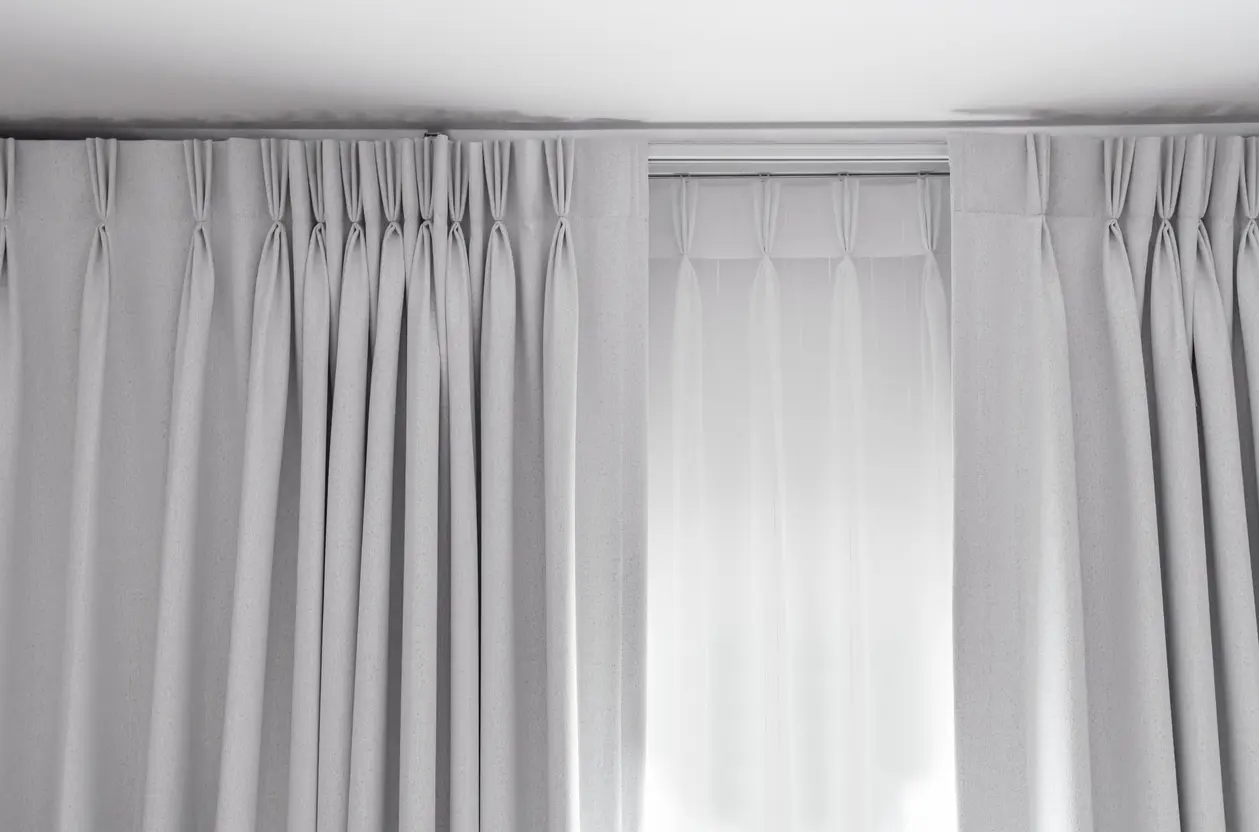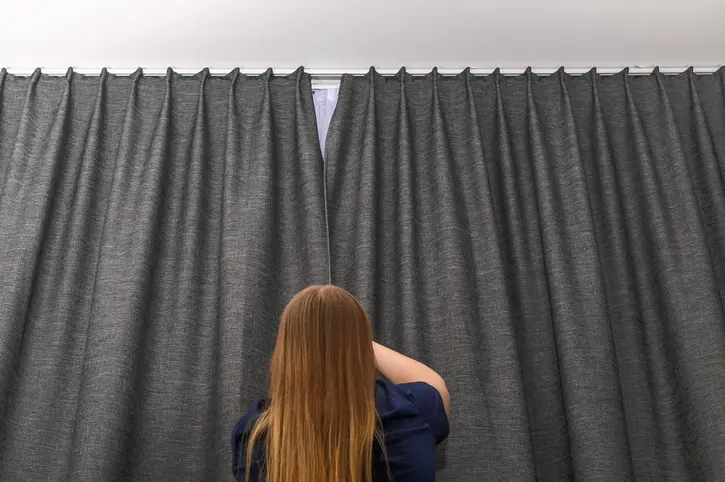

Measuring curtains correctly is essential for achieving a neat, professional finish. Whether you’re choosing floor-length curtains for a living room or made-to-measure curtains for a bedroom, accurate measurements help ensure the fabric hangs at the right height and covers the window properly.
To measure for curtains, start by measuring the usable width of your curtain pole or track, then measure the drop from the appropriate hanging point to where you want the curtains to finish. The exact method depends on your curtain heading and whether you’re using a pole, track or specialist system.
For example, pencil pleat curtains hanging from rings are measured differently from eyelet curtains, while wave curtains require measurements that match their dedicated hanging system.
This guide explains how to measure curtain width and drop, including the adjustments needed for different headings, poles and tracks.
What Do You Need to Measure Curtains?
Before you begin, gather the following:
- A metal tape measure.
- A pencil and paper or your phone for recording measurements.
- A stable stepladder if you need to reach the pole or track safely.
- Details of your intended curtain heading.
- The measuring instructions for your chosen pole or track, if available.
A rigid metal tape measure is generally more suitable than a flexible dressmaking tape because it is easier to keep straight over longer distances.
Where possible, record measurements in millimetres to avoid confusion when placing a made-to-measure order.
Important: This guide provides general measuring principles. Exact deductions, additions and manufacturing allowances vary between curtain makers and hanging systems. Confirm your supplier’s requirements before ordering.
Step 1: Measure the Curtain Width
The first measurement you’ll need is the curtain width.
For most conventional curtains, the important measurement is the usable width of the pole or track, rather than the width of the glass alone.
How to Measure an Existing Curtain Pole
If you already have a curtain pole:
- Locate the usable section of the pole between its end fittings.
- Measure the distance along the pole where the curtain rings or eyelets can travel.
- Exclude decorative finials from the measurement.
- Record the width in millimetres or centimetres.
For example, if the usable pole length is 220 cm, record 220 cm as the pole width.
The amount of fabric needed to cover this width will depend on the chosen curtain heading and fullness.
How to Measure an Existing Curtain Track
For a straight curtain track:
- Measure the usable track from one end to the other.
- Follow the shape of the track if it curves.
- Check whether the track has a centre overlap.
- Record the appropriate width for the particular track system.
If the track has an overlapping arm in the centre, the additional overlap may need to be included in the curtain-width calculation.
However, the correct method depends on the track design.
Don’t automatically add the lengths of two overlapping track sections without checking how the system is intended to be measured.
How to Measure if You Haven’t Installed a Pole or Track
If you’re planning to fit new hardware, start by measuring the width of the window opening.
As a general planning guide, a pole or track may extend around 15–20 cm beyond each side of the window where space permits.
For example:
| Measurement | Example |
|---|---|
| Window width | 180 cm |
| Extension on left | 20 cm |
| Extension on right | 20 cm |
| Proposed pole or track width | 220 cm |
This is an illustrative planning calculation, not a universal installation rule.
Larger or fuller curtains may need more space to stack beside the window when open.
Always consider the curtain heading, available wall space and location of nearby furniture before choosing the final width.
Step 2: Decide Where Your Curtains Should Finish
Next, decide on the desired curtain drop.
The drop is the vertical measurement used to determine the curtain’s finished length.
Common options include sill length, below-sill length and floor length.
Sill-Length Curtains
Sill-length curtains finish just above the windowsill.
Leaving around 1–1.5 cm of clearance is a common starting point for a neat, practical finish.
This style can be suitable for smaller windows or areas where furniture sits directly beneath the window.
Below-Sill Curtains
Below-sill curtains extend past the windowsill.
A drop of around 15 cm below the sill is a common design choice, although the ideal length depends on the window and surrounding furniture.
If a radiator sits below the window, take care not to choose a curtain length that obstructs it.
Floor-Length Curtains
Floor-length curtains create a tailored appearance and are popular in living rooms and bedrooms.
For curtains that clear the floor, a gap of around 1–1.5 cm is a common starting point.
The exact clearance depends on the flooring, fabric and finish you want.
If the floor is uneven, measure at several positions rather than assuming the distance is identical across the window.
Puddled Curtains
Puddled curtains deliberately extend beyond the floor, allowing some fabric to gather.
Adding approximately 5–15 cm to the floor-length drop can create different degrees of puddling.
This is a decorative choice rather than a requirement, and it may be less practical for curtains that are frequently opened or closed.
Step 3: Measure the Curtain Drop Correctly
The correct starting point depends on the curtain heading and hanging system.
This is where measuring errors commonly occur.
For some curtains, the measurement begins at the eye of a curtain ring. For others, it starts at the top of the pole or track.
Use the table below as an initial guide.
| Curtain heading and fitting | Common starting point |
|---|---|
| Pencil pleat on pole rings | Eye at the bottom of the curtain ring |
| Pinch pleat on pole rings | Eye at the bottom of the curtain ring |
| Pencil or pinch pleat on a track | Depends on whether the curtain sits below or conceals the track |
| Eyelet curtains | Top of the curtain pole, with heading allowance confirmed separately |
| Wave curtains | Reference point specified by the wave-track system |
| Other specialist headings | Follow the heading and fitting specifications |
Always check the measuring convention used by the curtain maker before submitting final dimensions.
Measure in Three Places
For a consistent finished length:
- Measure from the correct hanging point to the desired finish at the left.
- Repeat in the centre.
- Measure again on the right.
- Record all three figures.
For curtains intended to clear the floor, the shortest measurement is often used to help prevent the fabric dragging.
However, if the floor or ceiling is noticeably uneven, discuss the measurements with your curtain maker rather than assuming a single finished drop will produce the desired result across the entire width.
How to Measure for Pencil Pleat Curtains
Pencil pleat curtains use gathered heading tape to create narrow, regular folds.
They are commonly hung from curtain pole rings or track gliders.
Measuring Pencil Pleat Curtains on a Pole
For a conventional pole-and-ring arrangement:
- Measure the usable pole width, excluding the decorative finials.
- Locate the small attachment eye beneath the curtain ring.
- Measure vertically from this eye to the desired curtain finish.
- Repeat the drop measurement at the left, centre and right.
The curtain maker can then specify the heading position and required fabric allowance.
If you want the heading to cover more of the pole or rings, the measuring method may differ.
Measuring Pencil Pleat Curtains on a Track
For track-hung curtains, first establish whether the heading is intended to sit below the track or conceal it.
Some curtain systems specify measurements from the top of the track.
Others use the glider or hook attachment point.
Because the starting point affects the finished length, check the specifications for the actual track and heading.
Explore Zenn Interiors’ pencil pleat curtains to learn more about this versatile heading.
How to Measure for Pinch Pleat Curtains
Pinch pleat curtains feature permanently formed groups of folds, creating a structured appearance.
They can be used with compatible curtain poles or tracks.
Measuring Pinch Pleats on a Pole
For traditional pinch pleat curtains hanging from rings:
- Measure the usable pole width.
- Identify the ring’s attachment eye.
- Measure from the eye to the desired finished length.
- Take the drop measurement at several positions.
The exact heading allowance and hook position depend on how the pinch pleats are constructed.
Measuring Pinch Pleats on a Track
For a curtain track, the measuring point depends on the design of the track and the intended position of the heading.
The curtain maker should confirm whether the finished curtain is designed to hang below the track or partly conceal it.
Because pinch pleats are sewn into fixed positions, their construction and spacing should be planned in relation to the hardware.
Zenn Interiors offers bespoke pinch pleat curtains, including tailored double and triple pleat designs.
How to Measure for Eyelet Curtains
Eyelet curtains feature reinforced rings along the top of the fabric.
The pole passes directly through these eyelets, so the curtain hangs differently from curtains attached using separate hooks or rings.
Measuring Eyelet Curtain Width
Measure the usable length of the curtain pole, excluding its decorative finials.
Ensure that the pole diameter is compatible with the eyelets and that there is sufficient clearance for the fabric to move.
Measuring Eyelet Curtain Drop
- Measure from the top of the curtain pole to the intended bottom of the curtain.
- Record the measurement.
- Check how much fabric the selected eyelet heading requires above the pole.
- Confirm whether that allowance is included in the supplier’s required drop measurement.
For example, some eyelet curtain systems add approximately 3–4 cm above the pole as part of their manufacturing specification.
Do not automatically add this amount yourself. Some suppliers request the pole-to-hem measurement and make the adjustment during production, while others use a different convention.
Eyelet curtains generally require a compatible pole rather than a conventional curtain track.
How to Measure for Wave Curtains
Wave curtains use a specialist hanging system to create smooth, evenly spaced folds.
Unlike ordinary tape-headed curtains, the finished appearance depends on the relationship between the fabric, heading tape, carrier spacing and track.
For this reason, wave curtains should be measured according to the specifications of the chosen system.
Measuring Wave Curtain Width
For an existing straight wave track, measure the usable track length as instructed by the system manufacturer.
If the track has an overlap or other specialist component, follow its stated measuring requirements.
For a new installation, determine the proposed track width and consider the room available for the curtains to stack when open.
Measuring Wave Curtain Drop
Different wave systems use different reference points.
Some specifications measure from the top of the track, while others require a measurement from a defined point on the track or glider arrangement.
Follow the requirements of the system selected for your curtains.
Measuring Wave Curtains for a Recess
If the wave track will sit inside a window recess, measure:
- The recess width near the top, middle and bottom.
- The recess height at several positions.
- The available recess depth.
- The position of handles, vents or other obstructions.
A wave curtain needs enough clearance for the fabric folds to move without rubbing against the window or surrounding surfaces.
There is no single minimum recess depth suitable for every wave system.
The required space depends on the track, wave fullness, fabric and mounting arrangement.
Wave Curtains for Bay Windows
Bay-window installations require particular care because the track may need to follow angled or curved glazing.
Measurements should account for the actual track path, the bends and the available stacking space.
Not every wave system is suitable for every bay-window configuration.
Zenn Interiors offers wave pleat curtains and bespoke bay-window curtain tracks for suitable window arrangements.
How Much Extra Fabric Do You Need for Curtain Fullness?
Curtain fullness refers to the amount of fabric used in relation to the finished width that the curtains cover.
For example, a curtain with twice fullness uses approximately twice the finished coverage width in flat fabric before construction allowances.
However, different curtain headings require different amounts of fullness.
| Heading type | General consideration |
|---|---|
| Pencil pleat | Fullness depends on the heading tape and desired gather |
| Pinch pleat | Fabric allowance depends on pleat size and spacing |
| Wave | Fullness is determined by the wave-system specification |
| Eyelet | Fullness affects the depth and appearance of the folds |
| Cartridge and tailored pleat | Requirements depend on the bespoke heading construction |
Curtain Fullness Example
Suppose you have a pole measuring 220 cm.
If a particular heading is designed for approximately twice fullness, the starting calculation would be:
220 cm × 2 = 440 cm of flat fabric width.
This does not mean you should order a curtain with a finished width of 440 cm.
Finished curtain dimensions, flat fabric width, number of panels, seams, hems and heading allowances are different measurements.
For made-to-measure curtains, the maker should calculate the fabric quantity after the heading and fitting details have been confirmed.
Measuring Curtains for Bay Windows
Bay windows can be more complicated than straight windows because the pole or track may follow several angles or a continuous curve.
If you already have a shaped track, measure along its actual path rather than taking a straight measurement across the front of the bay.
Depending on the system, this may involve measuring individual straight sections and bends or using a flexible tape to follow the track.
If a new shaped track is required, the installer may also need:
- The dimensions of each bay section.
- The angles between sections.
- The fixing position.
- The available recess or ceiling space.
- The position of handles and other obstructions.
- Space for the curtains to stack when open.
A general straight-window formula cannot reliably account for all these details.
For complex bays, professional surveying is often the most dependable approach.
Curtain Measuring Example: A Living-Room Window
Let’s look at a simple example for conventional pencil pleat curtains hung from an existing pole.
Suppose you have:
| Measurement | Example |
|---|---|
| Usable curtain pole width | 220 cm |
| Desired curtain finish | 1.5 cm above the floor |
| Drop from ring eye to floor, left | 242 cm |
| Drop from ring eye to floor, centre | 241.5 cm |
| Drop from ring eye to floor, right | 242.5 cm |
For a practical floor-clearing finish, the shortest ring-eye-to-floor measurement is 241.5 cm.
Subtracting the desired 1.5 cm floor clearance gives:
241.5 cm − 1.5 cm = 240 cm
Your provisional measurements are therefore:
- Usable pole width: 220 cm.
- Required drop from the ring eye to the curtain hem: 240 cm.
These figures provide a basis for discussing the curtains with the maker.
The finished manufacturing dimensions still depend on the chosen heading, hook position and supplier’s measuring convention.
Common Curtain Measuring Mistakes
Measuring the Window Instead of the Pole or Track
For conventional curtains, the relevant width is usually the usable pole or track width.
Measuring only the glass can underestimate the area that the curtains need to cover.
Including Decorative Finials
Curtain finials sit at the ends of a pole and are not normally part of its usable width.
Measure the section along which the curtain can actually hang or travel.
Using the Wrong Drop Starting Point
Measuring from the top of a pole instead of the ring eye, or from the wrong part of a track, can alter the finished curtain length.
Always identify the correct hanging point.
Forgetting to Check the Floor Level
Floors are not always perfectly level.
A curtain that clears the floor on one side may touch it on the other if you rely on a single measurement.
Ignoring the Curtain Heading
Different headings require different fabric allowances and hanging systems.
Don’t assume measurements for pencil pleat curtains will work unchanged for eyelet or wave curtains.
Ordering Before the Hardware Is Confirmed
If the pole or track position changes after you measure, the required curtain drop may also change.
For an exact finished length, it is generally preferable to confirm the installed hardware position before finalising the measurements.
Confusing Fabric Width with Finished Curtain Width
A heading that requires additional fullness does not mean the finished curtains should cover a wider window.
The fabric quantity and finished coverage width are related but different measurements.
How to Check Your Curtain Measurements Before Ordering
Before submitting your dimensions, confirm the following:
- The curtain heading: Pencil pleat, pinch pleat, wave, eyelet or another style.
- The hanging system: Pole, track or specialist system.
- The usable width: Excluding finials and accounting for any specified overlap.
- The finished drop: Measured from the correct reference point.
- The intended finish: Sill, below sill, floor length or puddled.
- The number of panels: One curtain or a pair.
- Any obstructions: Radiators, handles, furniture or limited stacking space.
- The supplier’s measuring instructions: Including allowances and any system-specific requirements.
Where there is uncertainty, clarify the measurements before manufacture.
Frequently Asked Questions About Measuring Curtains
Do you measure curtains from the window or the pole?
For most conventional curtains, measure the usable width of the pole or track rather than the glass itself. If you’re fitting new hardware, measure the window first to plan the pole or track position.
How much wider should a curtain pole be than the window?
Extending a pole approximately 15–20 cm beyond each side is a common starting point. Larger curtains may require more stacking space, so the final measurement depends on the window and curtain design.
How far above a window should a curtain pole be fitted?
There is no universal fitting height. Around 10–15 cm above the opening is a common design starting point, but ceiling height, wall space, hardware and curtain proportions should determine the final position.
How far should curtains be from the floor?
For a neat floor-clearing finish, approximately 1–1.5 cm is a common allowance. Some designs are intended to touch the floor or puddle, so the correct length depends on the desired appearance.
How do you measure curtains for a track?
Measure the usable track width, then establish the correct drop reference point for the particular track and heading. This may be the top of the track or a specified attachment point.
How do you measure eyelet curtain length?
Measure from the top of the pole to the desired curtain finish, then follow the supplier’s instructions for the fabric allowance above the eyelet. Don’t add an arbitrary allowance without checking the manufacturing specification.
Do wave curtains need special measurements?
Yes. Wave curtains use a compatible track and carrier system. Width, drop, clearance and fabric fullness must follow that system’s specifications.
How do you measure curtains for a bay window?
Measure along the path of the intended pole or track, accounting for angles or curves. For a new bespoke bay track, a professional survey may be advisable.
Should I measure curtains before fitting the pole?
You can take provisional measurements to plan the installation and obtain an estimate. For precise made-to-measure curtains, confirm the final drop once the pole or track position is established.
Made-to-Measure Curtains in London
Correct measurements are the foundation of beautifully fitted curtains.
From the width of the pole or track to the finished drop and curtain heading, each detail affects how your window treatment looks and operates.
At Zenn Interiors, we specialise in bespoke made-to-measure curtains for London homes, with a choice of fabrics, linings, heading styles and hanging systems.
Our range includes pencil pleat, pinch pleat, wave, cartridge pleat and tailored pleat curtains, alongside bespoke curtain poles and tracks.
If you’re unsure how to measure a particular window or need guidance on the most suitable hanging arrangement, contact Zenn Interiors to discuss your requirements.
Telephone: 020 7871 3082
Email: zenninteriors@gmail.com