Curtains collect dust, household odours and occasional stains over time. Keeping them clean helps maintain their appearance, but using the wrong washing method can cause shrinkage, colour changes or damage to delicate fabrics and linings.
The safest way to wash curtains is to check the care label first, then follow the instructions for the complete curtain construction. Some lightweight, unlined curtains can be machine-washed on a gentle cycle, while many lined, interlined, velvet and silk curtains require professional cleaning.
Even when the face fabric appears washable, the lining, heading tape or decorative finish may not be.
This guide explains how to wash different types of curtains, when to avoid machine washing and how to keep made-to-measure curtains looking their best.
Can You Wash Curtains in a Washing Machine?
Yes, some curtains can be washed in a domestic washing machine.
However, not all curtains are machine washable, and the fabric type alone doesn’t determine whether washing is safe.
Before washing, check:
- The sewn-in care label.
- Whether the curtains are lined or interlined.
- The fabric composition.
- Whether there is a blackout or thermal coating.
- The construction of the heading.
- Any decorative trims or embellishments.
- Whether the fabric has become weakened by sunlight or age.
If the curtains have no care label or their construction is unclear, seek advice from the original supplier or a professional curtain cleaner.
Don’t assume that a gentle cycle makes an otherwise unsuitable curtain safe to machine-wash.
Curtain Cleaning Methods at a Glance
| Curtain type | General cleaning guidance |
|---|---|
| Lightweight unlined polyester | May be machine washable if the care label permits |
| Cotton curtains | Some can be washed, but shrinkage and colour changes are possible |
| Linen curtains | Follow the label; some require professional cleaning |
| Sheer and voile curtains | Often suitable for gentle hand or machine washing if specified |
| Lined curtains | Professional cleaning is often safer because layers may shrink differently |
| Interlined curtains | Usually best assessed by a professional curtain cleaner |
| Velvet curtains | Generally require specialist care to protect the pile |
| Silk curtains | Usually require specialist cleaning |
| Blackout curtains | Depends on the fabric or lining; coated backings need particular care |
| Pleated or heavily embellished curtains | May require professional cleaning to protect their construction |
This table provides general guidance. The care instructions for the individual curtains always take priority.
How to Wash Machine-Washable Curtains
If the care label explicitly permits machine washing, follow these steps.
Step 1: Remove Dust
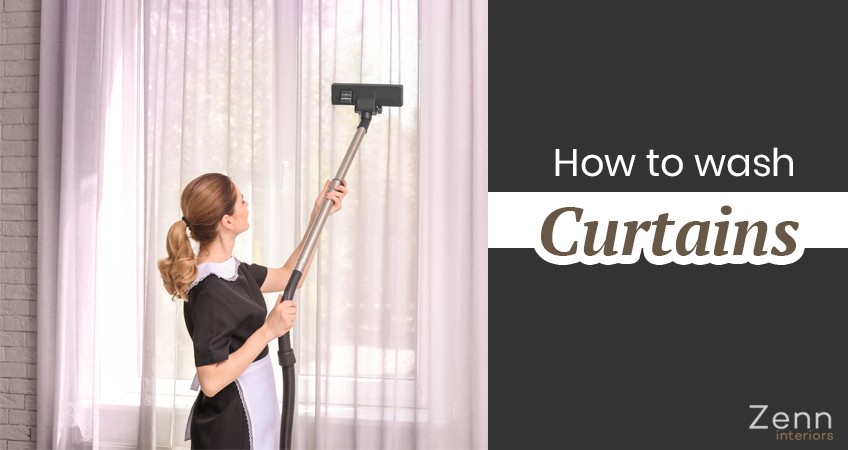
Before taking down the curtains, gently vacuum them using a soft upholstery attachment and a low suction setting.
Work carefully along the folds without pulling or stretching the fabric.
This helps remove surface dust before washing.
Step 2: Take Down the Curtains
Remove the curtains carefully from their pole or track.
For pencil pleat curtains, remove the hooks and secure any loose gathering cords so they cannot become tangled.
Check the curtain manufacturer’s instructions before loosening or adjusting the heading.
Keep small hooks and fittings together so they’re easy to replace.
Step 3: Check the Care Label Again
Confirm the permitted:
- Washing temperature.
- Cycle type.
- Detergent requirements.
- Spin speed, if specified.
- Drying method.
- Ironing temperature.
Do not use a higher temperature or stronger cycle than the label allows.
Step 4: Avoid Overloading the Machine
Curtains can become heavy when wet.
Wash panels separately if necessary, allowing enough room for the fabric to move without excessive compression.
Large or heavy curtains may be unsuitable for a domestic machine even when the material itself is washable.
Step 5: Use a Suitable Detergent
Choose a detergent compatible with the fabric and care instructions.
Avoid bleach unless the label specifically allows it.
A mild detergent may be appropriate for certain washable curtains, but the fabric’s instructions should determine the final choice.
Step 6: Select the Correct Cycle
Use the temperature and cycle recommended by the manufacturer.
Where permitted, a gentle or delicate cycle can reduce mechanical stress on lightweight fabrics.
Avoid unnecessarily high spin speeds if the care instructions advise against them.
Step 7: Dry the Curtains Correctly
Follow the drying symbols on the label.
Many washable curtains are best air-dried rather than tumble-dried, but the correct method depends on the material.
Support the fabric appropriately while drying to avoid stretching, distortion or pressure marks.
Don’t place curtains directly against radiators or other concentrated heat sources.
How to Hand-Wash Curtains
Some delicate curtains can be hand-washed, provided their care instructions allow washing in water.
Hand washing may be suitable for certain lightweight sheers, voiles and unlined fabrics.
Step-by-Step Instructions
- Check that the curtains are suitable for hand washing.
- Fill a clean basin or bath with water at the permitted temperature.
- Add a small amount of suitable detergent.
- Submerge the curtains gently.
- Move the fabric through the water without aggressive rubbing or twisting.
- Rinse carefully until detergent residue is removed.
- Remove excess water using the method permitted by the care label.
- Dry the curtains as instructed.
Avoid wringing delicate fabric, as this can stretch or distort its fibres.
Large curtains may be difficult to support when wet. If the panels are particularly heavy or delicate, professional cleaning may be more appropriate.
How to Clean Sheer and Voile Curtains
Sheer curtains are often made from lightweight fabrics that can be more delicate than they appear.
Some polyester voiles can be washed at home, while other sheer fabrics require specialist care.
Cleaning Sheer Curtains
If the care label allows washing:
- Remove hooks and other detachable fittings.
- Use the permitted gentle washing method.
- Avoid overloading the machine.
- Handle the wet fabric carefully.
- Allow the curtains to dry according to the label.
Sheer fabrics can snag on rough surfaces, exposed zips or other items in the wash.
For this reason, avoid washing them alongside garments or household textiles that could catch the material.
If the sheers have delicate embroidery, specialist finishes or extensive sun damage, seek cleaning advice before using water.
Zenn Interiors offers made-to-measure sheer curtains for homes where soft daylight and decorative layering are priorities.
Can You Wash Lined Curtains?
Lined curtains need particular care because they contain more than one layer of fabric.
The decorative face fabric and the lining may have different fibre compositions and react differently to water.
If one layer shrinks more than the other, the curtain may develop:
- Puckering.
- Uneven hems.
- Distorted folds.
- A lining that pulls against the face fabric.
- Permanent changes to the finished drop.
This is why professional cleaning is often recommended for lined curtains.
Don’t put lined curtains in a washing machine unless the care instructions for the complete product explicitly permit it.
A washable face fabric doesn’t necessarily mean the finished curtain is washable.
Explore Zenn Interiors’ bespoke lined curtains.
How to Clean Interlined Curtains
Interlined curtains have an additional layer between the decorative fabric and lining.
This construction creates a fuller appearance and can improve thermal comfort at windows.
However, the different layers make cleaning more complicated.
Washing an interlined curtain in water can cause the layers to shrink or change shape at different rates.
The additional weight of wet fabric can also put strain on the heading and stitching.
For this reason, professional cleaning is generally the safer starting point for interlined curtains, subject to their specific care instructions.
A cleaner experienced with bespoke curtains can assess the fabric, interlining, construction and potential risks before recommending a method.
Zenn Interiors provides bespoke interlined curtains for customers seeking a fuller, more substantial window treatment.
How to Clean Blackout Curtains
Blackout curtains require careful attention because different products achieve their light-blocking effect in different ways.
Some use a densely woven blackout material.
Others use a separate blackout lining or a specialist coating.
The cleaning requirements can therefore vary considerably.
Blackout Curtains with Coated Backings
A coated lining may be sensitive to heat, friction or certain cleaning chemicals.
Unsuitable washing or drying can cause the coating to crack, stick, peel or lose its appearance.
Avoid ironing directly onto a coated backing unless the manufacturer specifically permits it.
Blackout Curtains with Separate Linings
If the blackout material forms part of a lined curtain, differential shrinkage may be a concern.
The full curtain construction must be assessed before washing.
The safest approach is to follow the specific care label rather than assuming all blackout curtains can be washed the same way.
Explore Zenn Interiors’ made-to-measure blackout curtains.
How to Clean Velvet Curtains
Velvet has a distinctive raised pile that gives it a soft texture and rich appearance.
That pile can be affected by pressure, moisture and inappropriate cleaning.
Machine washing may flatten or distort the surface, while excessive rubbing can create visible changes in its appearance.
Some velvet fabrics also develop pressure marks or shading during normal use.
Caring for Velvet Curtains
- Follow the fabric’s care instructions.
- Remove dust gently using an appropriate method.
- Avoid aggressive brushing or rubbing.
- Do not apply direct heat without checking the manufacturer’s advice.
- Seek specialist cleaning guidance for stains or extensive soiling.
Different velvets have different fibre compositions and finishes, so one cleaning method won’t suit every product.
For expensive or bespoke velvet curtains, professional assessment is generally preferable to experimenting with household cleaning products.
How to Clean Linen and Cotton Curtains
Cotton and linen are natural fibres, but this doesn’t automatically make them suitable for machine washing.
Some unlined cotton curtains can be washed at home.
Other cotton or linen curtains may shrink, crease or change appearance, particularly if they’ve been constructed with specialist headings or linings.
Cotton Curtains
Check whether the fabric is washable and whether any lining or heading affects the cleaning method.
Use only the temperature and washing process stated on the label.
Linen Curtains
Linen can develop natural creases during use and cleaning.
Some linen and linen-blend fabrics require professional cleaning to maintain their intended drape and dimensions.
Do not assume that a linen-blend fabric has the same care requirements as pure linen.
For both materials, consider the complete curtain construction rather than making a decision based on the fibre name alone.
How to Remove Stains from Curtains
If a drink, food or another substance comes into contact with your curtains, the correct response depends on the stain and the fabric.
Acting promptly can help, but using an unsuitable product may cause more damage than the original stain.
Step 1: Identify the Fabric and Stain
Check the care instructions and consider what caused the mark.
A water-based drink, oily substance and ink stain may require different treatment.
Step 2: Avoid Rubbing
For a fresh liquid spill, gently blot excess moisture with a clean, absorbent cloth if appropriate for the fabric.
Avoid spreading the stain or pushing it further into the fibres.
Step 3: Don’t Apply Household Chemicals Without Checking
Vinegar, rubbing alcohol, stain removers and general-purpose cleaning sprays can affect dyes, fabric finishes and coatings.
Even products commonly recommended for household cleaning may be unsuitable for delicate curtains.
Don’t apply an unapproved chemical simply because it works on another textile.
Step 4: Seek Suitable Cleaning Advice
For washable fabric, follow the manufacturer’s stain-treatment instructions.
For lined, interlined, velvet, silk or valuable bespoke curtains, consider professional cleaning advice before attempting a treatment.
Some marks cannot be removed completely without risking damage to the material.
How to Clean Curtains Without Taking Them Down
Not every curtain needs washing to look fresh.
Routine maintenance may remove dust and reduce the need for more intensive cleaning.
Gentle Vacuuming
Use a soft upholstery attachment on a low suction setting.
Work carefully along the fabric folds, supporting delicate material where necessary.
Avoid pulling on loose threads or decorative trims.
Light Dusting
A suitable soft brush may help remove loose surface dust from certain fabrics.
Always use a method appropriate for the material.
Airing the Room
Ventilating the room in suitable conditions can help reduce some household odours and moisture.
However, airing won’t remove embedded stains or replace cleaning where significant soiling has occurred.
Professional Cleaning in Place
Some specialist cleaners offer curtain cleaning without removing the panels.
Whether this is appropriate depends on the fabric and process used.
For delicate or complex curtains, ask the cleaner to assess the material and explain the proposed treatment before work begins.
What If Your Curtains Are Sun-Damaged?
Prolonged exposure to sunlight can weaken certain fibres and cause colours to fade.
Fabric that has become brittle or fragile may tear during handling or washing.
Washing cannot reverse fading or restore the original strength of sun-damaged fibres.
If your curtains show signs of significant deterioration:
- Avoid aggressive brushing or washing.
- Check whether the fabric feels unusually weak.
- Inspect the lining and seams.
- Seek specialist advice before cleaning.
- Consider whether repairs or replacement are more practical.
In some cases, replacing a damaged lining may be possible while preserving the decorative fabric.
However, this depends on the curtain’s condition and construction.
Can You Wash Curtains That Have Rips or Loose Seams?
Curtains with tears, damaged heading tape or loose stitching should be assessed before cleaning.
Water and mechanical movement can enlarge existing damage.
For example, a small tear in weakened fabric may become substantially worse during a washing cycle.
Similarly, a loose heading could be placed under additional strain when the curtain becomes wet.
For damaged bespoke curtains, it may be better to arrange a suitable repair before cleaning.
Iron-on repair products aren’t appropriate for every material, particularly heat-sensitive fabrics, specialist linings and delicate finishes.
How to Dry Curtains Without Damaging Them
Drying is just as important as washing.
The wrong method can cause shrinkage, pressure marks, distortion or damage to coatings.
Follow the Care Label
Only tumble-dry curtains if the label specifically permits it.
Many curtain fabrics and linings are unsuitable for tumble drying.
Avoid Concentrated Heat
Don’t place curtains directly over radiators or against other intense heat sources.
Heat can affect fibres, linings and specialist coatings.
Support Heavy Fabric
Wet curtains can be significantly heavier than dry ones.
Use a suitable drying arrangement that supports the fabric without stretching it or creating pressure marks.
Avoid Prolonged Strong Sunlight Where Inappropriate
Some dyed fabrics are vulnerable to fading or colour changes.
Follow the manufacturer’s drying instructions rather than assuming that direct sunlight is the best option.
Check Before Rehanging
Make sure the curtains are sufficiently dry for the intended installation.
Rehanging damp material in a poorly ventilated area may contribute to moisture problems.
Can You Iron or Steam Curtains?
Some curtains can be ironed or steamed, while others require specialist handling.
Always check the care label.
Ironing
If ironing is permitted, use the recommended temperature and method.
Avoid applying direct heat to delicate finishes or specialist coatings.
For velvet and other pile fabrics, direct pressure can alter the surface.
Steaming
Steaming may help reduce creases in certain curtain fabrics.
However, steam introduces both heat and moisture.
It may damage sensitive materials, cause water marking or affect structured headings.
Don’t assume steaming is safe simply because it doesn’t involve placing an iron directly onto the fabric.
Professional Finishing
For valuable made-to-measure curtains, specialist finishing may be preferable where the fabric or construction is sensitive to heat.
How Often Should Curtains Be Cleaned?
There isn’t one cleaning schedule suitable for every home.
The appropriate frequency depends on:
- Household dust levels.
- Whether windows are regularly opened.
- Exposure to cooking odours or smoke.
- Pets and other household activity.
- Fabric type and construction.
- Any allergies or particular hygiene requirements.
- The manufacturer’s care recommendations.
Regular gentle dust removal can help maintain appearance between deeper cleans.
Full washing or professional cleaning should be based on the curtain’s condition and care requirements, rather than an arbitrary rule that every pair needs washing every few months.
When Should You Use a Professional Curtain Cleaner?
Professional cleaning is worth considering when:
- The curtains are labelled dry-clean only.
- They have several sewn-in layers.
- The fabric is silk, velvet or another delicate material.
- The heading has detailed or structured construction.
- The curtains contain specialist coatings.
- There are significant stains.
- The fabric is faded or fragile.
- The curtains are particularly large, heavy or valuable.
- No reliable care information is available.
When speaking to a cleaner, explain the curtain’s construction and ask whether the proposed process is suitable.
Also ask about potential shrinkage, colour changes, collection, rehanging and the treatment of existing damage.
Professional cleaning reduces some risks but cannot guarantee that every aged or delicate fabric will remain unchanged.
Frequently Asked Questions About Washing Curtains
Can you put curtains in the washing machine?
Some curtains can be machine-washed, particularly certain lightweight, unlined fabrics. Check the care label and the complete curtain construction before washing.
Can you wash lined curtains?
Only if the care instructions for the finished curtains permit it. Different fabric layers can shrink at different rates, so professional cleaning is often safer.
Can you machine-wash blackout curtains?
It depends on the construction and care instructions. Some blackout materials are washable, while coated linings and complex curtain constructions may require specialist treatment.
Can you wash velvet curtains?
Some velvet fabrics have specific cleaning methods, but many are unsuitable for ordinary machine washing. Check the care instructions and seek professional advice where appropriate.
Can you wash curtains at 30°C?
Only if the care label permits washing at that temperature. A 30°C cycle isn’t automatically safe for all curtains.
How do you wash curtains without shrinking them?
Follow the manufacturer’s permitted cleaning method. Where washing could cause shrinkage, professional cleaning may be more appropriate. There is no guaranteed household technique that prevents every fabric from shrinking.
Can you wash curtains with hooks still attached?
Removable hooks should generally be taken out before washing, provided the curtains are washable. Metal or plastic fittings may damage the fabric or washing machine.
Can you tumble-dry curtains?
Only if the care label permits it. Many curtain fabrics and linings require air drying or specialist handling.
How do you remove stains from expensive curtains?
Avoid experimenting with vinegar, alcohol, bleach or other household chemicals. Identify the fabric and seek suitable specialist cleaning advice, particularly for velvet, silk and lined curtains.
Can dry cleaning shrink curtains?
Some curtains can still experience dimensional changes during professional cleaning. Ask the cleaner to assess the fabric and explain the potential risks before proceeding.
How do you clean curtains without taking them down?
Gentle vacuuming with a suitable upholstery attachment can remove surface dust. Some curtains may also be suitable for professional cleaning in place.
Caring for Bespoke Curtains in London
Made-to-measure curtains are designed to complement your windows through carefully selected fabrics, linings and tailored construction.
Looking after them properly helps preserve their appearance and reduces the risk of avoidable damage.
At Zenn Interiors, we specialise in bespoke made-to-measure curtains for London homes, including sheer, lined, blackout and interlined designs.
Whether you’re considering new curtains for a bedroom, living room or bay window, understanding the fabric and lining options can help you choose a window treatment that suits your style and maintenance preferences.
Explore our luxury curtain collection or contact Zenn Interiors to discuss your window treatment requirements.
Telephone: 020 7871 3082
Email: zenninteriors@gmail.com