The best curtain track for bay windows is usually one that can follow the shape of the bay accurately while supporting the weight of the chosen curtains and allowing them to move smoothly around each bend.
In many cases, that means using a purpose-made bendable or curved track rather than trying to adapt a standard straight track.
However, there is no single system that works best for every bay.
A shallow three-sided bay has different requirements from a deep Victorian-style bay with several angles. Lightweight decorative curtains place different demands on the track from full-length lined curtains. The available wall and ceiling structure also influences where the track can be fixed.
The most successful result comes from considering the track, curtains and architecture together.
Zenn Interiors provides made-to-measure curtains and curtain poles and tracks, so the fixing system can be considered as part of the overall window treatment rather than as a separate afterthought.
Why are bay windows more difficult to curtain?
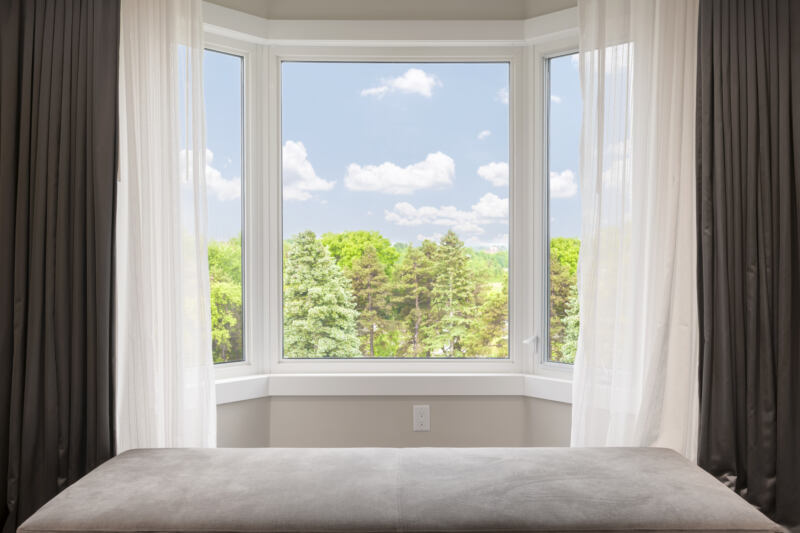
Bay windows are attractive because they project out from the main wall and bring additional light into a room.
That same geometry makes them more complicated to dress.
A conventional straight window usually needs one pole or track running from one side to the other.
A bay may contain:
- several angled sections
- curved corners
- narrow returns
- different window widths
- limited wall space beside the glazing
- radiators or furniture beneath the window
Curtains also need somewhere to sit when they are open.
If the track is badly positioned, the curtains can bunch awkwardly into the corners or cover more of the glazing than intended.
A bay window track therefore needs to do more than simply support the fabric. It has to guide the curtains through the shape of the window while leaving enough room for them to stack neatly.
What type of curtain track can follow a bay window?
A bendable curtain track is often the most practical solution.
These tracks are designed so they can be shaped to follow the angles or curves of the bay.
Depending on the system, the track may be formed on site or manufactured to the required shape.
The main advantage is continuity.
Rather than stopping and starting at every angle, a suitable track can create one continuous route for the curtains.
This can make opening and closing much smoother.
It also creates a cleaner visual finish than using several unrelated straight sections.
For more complicated bays, a made-to-measure system is particularly valuable because the exact angles and dimensions can be incorporated into the design.
Is a curved track better than several straight tracks?
Often, yes, but not always.
A continuous curved or bent track allows curtain gliders to travel around corners.
This means the curtains can potentially move from one side of the bay to the other without interruption.
Separate straight tracks can create stopping points at each angle.
That may be acceptable where the curtains are intended to remain within individual sections, but it can be less convenient if the aim is to draw them across the entire bay.
The correct approach depends on how the curtains are supposed to operate.
If you want one pair of curtains to travel around the complete shape, a continuous track is usually more suitable.
If each window section has its own curtain treatment, separate tracks may work perfectly well.
Can one pair of curtains cover the whole bay?
In many cases, yes.
A properly specified continuous track can allow a pair of curtains to meet in the centre and then travel back around the bay when opened.
However, several practical issues need to be considered.
The fabric has to move freely around each bend.
There also needs to be enough space at either end for the curtains to stack.
A large bay with heavy, full curtains can produce a substantial stack of fabric.
If the track ends too close to the outer edges of the glass, that fabric may remain partly in front of the window even when fully open.
This can reduce daylight and make the window feel narrower.
Where possible, extending the track beyond the glazing can help the curtains stack more effectively, although the available wall space may limit this.
How tight can a curtain track bend?
That depends on the particular track system.
Not every bendable track can accommodate every angle or radius.
Some systems can form relatively tight bends, while others need a gentler curve.
This is particularly important in bay windows with sharp corners.
If a track is forced into a tighter bend than it is designed for, the gliders may not move smoothly.
The curtain can then snag or require excessive force to pull around the corner.
The geometry of the bay therefore needs to be measured accurately before the track is chosen.
It is not enough to know that the window is “a bay”.
The actual angles matter.
Does curtain weight affect which track you need?
Very much so.
Curtain fabric can become surprisingly heavy once the complete treatment is assembled.
The finished weight may include:
- face fabric
- lining
- interlining
- heading
- trims
- additional fullness
A lightweight unlined curtain places relatively little demand on the track.
A pair of full-length lined or interlined curtains can be considerably heavier.
The track system and fixings therefore need to be capable of supporting the finished treatment.
This is particularly important around bends, where smooth movement becomes more demanding.
Choosing a track solely because it can physically bend around the bay is not enough.
Its load capacity also needs to suit the curtains.
Are heavy curtains more difficult around bay windows?
They can be.
Heavy curtains create more resistance when moving through bends.
If the track is underspecified, the curtains may become difficult to draw.
Poor fixing can also lead to movement or strain on brackets.
This is why curtain fabric and track should ideally be specified together.
If you plan to use a substantial fabric, blackout lining or interlining, that needs to be known before the track is selected.
A stronger system with appropriate gliders and fixings may be required.
The same applies to long curtains.
Even a moderately weighted fabric can become substantial when it extends from ceiling to floor across a wide bay.
Should a bay window track be ceiling or wall mounted?
Either can work.
The best option depends on the architecture and the intended appearance.
Ceiling-mounted tracks
Ceiling fixing can create a clean, integrated look.
The curtains appear to fall directly from above, which can visually increase the height of the room.
This can work particularly well in contemporary interiors.
Ceiling fixing can also be useful where there is limited wall space above the window.
However, the ceiling structure must provide a suitable fixing point.
Wall-mounted tracks
Wall fixing can be more appropriate where the space above the window is suitable and the track needs to sit forward from the glazing.
This can help clear window handles, shutters or deep sills.
The brackets also allow the track position to be adjusted away from the wall.
The choice should therefore be based on both appearance and clearance.
How far should the track sit from the window?
There must be enough space for the curtains to hang and move without catching.
Factors that can affect the required projection include:
- window handles
- deep sills
- radiators
- blinds
- shutters
- the depth of the curtain folds
- the chosen heading style
This becomes especially important if the bay window is being layered with another window treatment.
For example, Roman blinds may sit within each section of the bay while curtains run on a track in front.
The track needs enough clearance for both systems to operate independently.
If the curtains brush against handles or blinds every time they move, the arrangement is unlikely to feel successful in everyday use.
How does the curtain heading affect the track?
The heading influences both appearance and how easily the curtain travels.
Track systems are commonly used with headings designed to work with gliders or hooks.
The amount of fullness also matters.
A fuller curtain contains more fabric, creating a larger stack when open.
This can influence the amount of track needed outside the main glazed area.
The heading should therefore be chosen with the proportions of the bay in mind.
A very full curtain can look luxurious in a generous room, but it may overwhelm a smaller bay where stacking space is limited.
The track and curtain design need to be considered together.
Where should curtains stack in a bay window?
Ideally, the curtains should stack where they obstruct as little glazing as possible.
This is one of the most overlooked parts of bay-window planning.
It is easy to focus on how the curtains look when closed, but they may spend most daylight hours open.
If the stack sits directly in front of the outer panes, it can significantly reduce the amount of natural light entering the room.
Where wall space exists beyond the bay, extending the track can allow the curtains to move farther away from the glass.
Some bays do not provide much external wall space, so compromises may be necessary.
In those cases, the curtain width, fullness and fabric thickness become even more important.
Can curtains run around several corners?
Yes, provided the track is designed for that purpose and the bends are suitable.
A multi-angle bay may require the track to change direction several times.
Smooth-running gliders become particularly important.
Each bend creates another point where resistance can increase.
This is why a quality track system and accurate installation matter more on a complex bay than on a conventional straight window.
If the track contains abrupt changes of direction or poorly formed joints, the curtain may drag or catch.
The system should feel straightforward to operate despite the complicated window shape.
Is a curtain pole suitable for a bay window?
It can be.
Bay-window poles are available with corner joints that allow separate pole sections to follow the shape of the bay.
They can create a more decorative appearance than a discreet track.
A visible pole can become part of the room design, particularly in traditional interiors.
However, poles and tracks behave differently around corners.
A track often provides a smoother continuous route for gliders.
A pole uses rings and corner joints, which may affect how far curtains can travel.
The best choice therefore depends on whether the priority is decorative hardware or particularly fluid movement.
Zenn Interiors works with both curtain poles and tracks, allowing the hardware to be selected according to the window and the intended finish.
Which works better in a traditional bay window?
Both tracks and poles can work well in traditional interiors.
The decision depends on whether you want the hardware to be seen.
A decorative pole can complement:
- period detailing
- traditional furniture
- timber flooring
- decorative curtain headings
- classic fabrics
A discreet track keeps the focus on the curtains and architecture.
This can be particularly useful where the fabric itself has a strong pattern or rich texture.
There is no requirement for a traditional bay window to use a decorative pole.
A concealed or understated track can still work extremely well in a period room.
Which works better in a contemporary bay?
A slim ceiling-mounted track often suits contemporary interiors.
It reduces visual clutter and allows the curtain fabric to become the main feature.
Floor-to-ceiling curtains can also emphasise height and create a more architectural look.
However, the proportions still need to suit the room.
Simply mounting a track at ceiling height does not automatically create a better result.
The curtain length, width, heading and stacking position all contribute to the final effect.
What should be measured before choosing the track?
Accurate measurement is critical.
A bay needs more than a simple width measurement.
Relevant dimensions may include:
- width of each window section
- angle between each section
- overall track length
- available wall space outside the bay
- ceiling height
- distance from the fixing point to the glazing
- position of handles
- radiator projection
- depth of blinds or shutters
- desired curtain length
Small inaccuracies can become significant when several angles are involved.
If the first bend is slightly misplaced, the error can affect the position of everything that follows.
Made-to-measure bay treatments therefore benefit from careful surveying before manufacture.
What happens if the track is too close to the window?
The curtain may catch against handles, frames or other window treatments.
This can make operation frustrating and may cause the fabric to rub against surfaces repeatedly.
It can also affect how the curtains hang.
Instead of falling naturally, the folds may be pushed forward or distorted by whatever sits behind them.
The correct projection gives the curtain enough space to form properly.
This is especially important with heavier fabrics and fuller headings.
What happens if the track is too far into the room?
Moving the track unnecessarily far from the window can also cause problems.
The curtains occupy more room and may look disconnected from the window.
They can interfere with furniture or reduce usable space around the bay.
The aim is not to maximise projection.
It is to provide enough clearance for the treatment to operate properly while keeping it visually connected to the architecture.
Should you choose the track before the curtains?
Ideally, the two should be planned together.
The curtain specification determines how much weight the track must carry.
The track position affects how the curtains hang.
The available stacking space influences how much fullness is practical.
The heading affects how the curtains connect to the track.
Choosing each component separately can therefore lead to unnecessary compromises.
For example, selecting very heavy interlined curtains and only afterwards discovering that the preferred lightweight track cannot support them creates an avoidable problem.
A coordinated approach is much more reliable.
How do you choose the best track for your bay window?
Start with the shape and function of the bay rather than the appearance of the track.
Ask:
- How many bends are required?
More complex bays need a track designed for smooth travel around multiple corners. - How heavy will the curtains be?
The system and fixings must support the complete finished curtain. - Where will the curtains stack?
Enough space is needed to keep fabric away from the glazing where possible. - What needs to be cleared?
Check handles, radiators, blinds, shutters and window sills. - Should the hardware be visible?
A track can be discreet, while a pole can become a decorative feature. - Where can the track be fixed securely?
Wall and ceiling construction can affect the available options.
Once these questions are answered, choosing between systems becomes much easier.
Frequently Asked Questions
Can a curtain track bend around a 90-degree corner?
Some track systems can accommodate relatively tight bends, but the permissible radius depends on the specific product. The track should not be forced beyond its intended limits.
Can you put curtains across the front of a bay instead?
Yes. Instead of following the bay, a straight track can sometimes be fitted across the front opening. This creates a different effect and may reduce access to the bay area when the curtains are closed, so the way the space is used should be considered.
Do bay window curtains need to touch the floor?
No. Floor-length curtains are common, but the appropriate length depends on the window, room and furniture arrangement. Radiators and window seats may affect what is practical.
Can Roman blinds and curtains be used together in a bay window?
Yes. Individual Roman blinds can dress the glazed sections while curtains provide a softer outer layer. Enough clearance must be allowed so the two treatments do not interfere with each other.
Are made-to-measure tracks better for unusual bay windows?
They can be particularly useful where the bay has several angles, unusual proportions or limited fixing space because the system can be designed around the actual dimensions rather than adapted from a standard straight installation.
The best curtain track for a bay window is one that follows the architecture accurately, supports the finished curtain weight and allows the fabric to move smoothly without wasting valuable window space.
For many bays, a purpose-made curved or bendable track offers the most flexible solution. However, the choice between wall and ceiling fixing, track and pole, or one continuous system and several sections depends on the individual window.
The key is to plan the track and curtains as one complete treatment.
Zenn Interiors provides bespoke curtains alongside curtain poles and tracks, allowing the fabric, heading, fixing position and hardware to be considered together for a balanced finished result.
Phone: 020 7871 3082
Email: zenninteriors@gmail.com
Find out more: https://zenninteriors.co.uk/