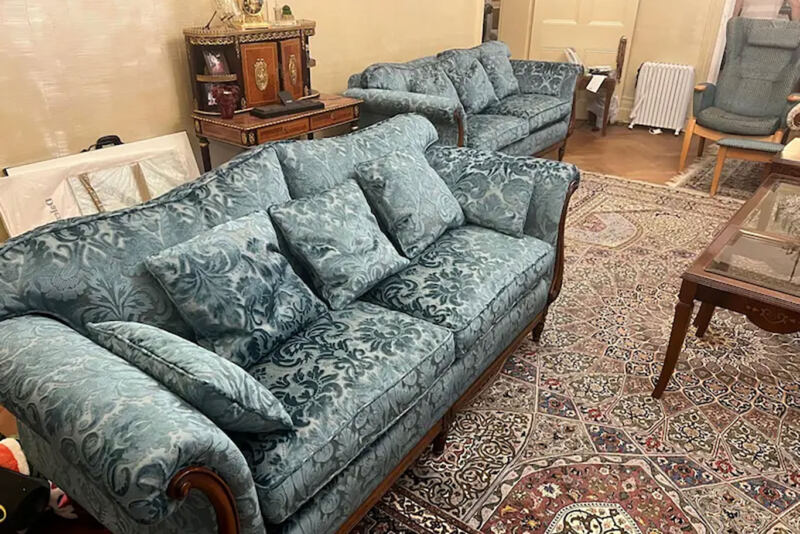
Traditional furniture can often be reupholstered very successfully for a contemporary interior.
In fact, one of the strengths of reupholstery is that it allows the underlying character, craftsmanship and proportions of an older piece to be retained while changing the surface treatment that gives it much of its visual identity.
A traditionally shaped armchair upholstered in a dark patterned fabric can feel completely different when recovered in a restrained textured neutral. A classic sofa can become far more contemporary when heavy trims are removed and a simpler fabric is introduced.
The aim does not have to be to disguise the age or style of the furniture.
Often, the most successful result comes from allowing the traditional shape to remain visible while using upholstery to create a deliberate contrast with the surrounding modern interior.
Zenn Interiors provides bespoke upholstery services for furniture including sofas, armchairs, headboards, bench seats and footstools, allowing fabric and finish choices to be considered as part of the wider room scheme.
Why can traditional furniture work in a contemporary room?
Contemporary interiors do not have to contain exclusively contemporary furniture.
Rooms often feel more considered when they contain pieces from different periods, provided those pieces relate to one another through colour, proportion or material.
Traditional furniture can bring qualities that a room full of newer pieces may lack.
These might include:
- distinctive silhouettes
- carved timber
- curved arms
- turned legs
- deeper proportions
- decorative detailing
- a greater sense of age and character
The upholstery has a significant influence on how those features are perceived.
A chair with a traditional frame and floral upholstery may read as strongly conventional.
The same chair in a plain woven fabric may instead feel like a sculptural vintage piece within a modern scheme.
Reupholstery therefore provides an opportunity to change the balance between old and new without removing what makes the furniture distinctive.
What makes a piece of traditional furniture suitable for reupholstery?
Appearance alone should not determine whether a piece is worth recovering.
The underlying condition matters.
A sofa or armchair may have an attractive frame but still require more than a simple change of fabric.
Before reupholstery, it is sensible to consider:
- the structural condition of the frame
- whether joints remain sound
- the condition of springs or internal support
- the state of padding or cushioning
- whether the piece remains comfortable
- whether its proportions still suit the room
- whether the original design has features worth retaining
Reupholstery makes the most sense when the furniture itself still has value to the owner, whether because of its construction, comfort, design or sentimental importance.
A new fabric cannot compensate for fundamental structural problems unless those issues are addressed as part of the work.
Which upholstery fabrics make traditional furniture feel more contemporary?
Fabric can change the character of a piece dramatically.
For a more contemporary result, simpler fabrics often work particularly well.
This does not necessarily mean the material has to be plain.
Texture can create visual interest while keeping the overall effect restrained.
Suitable approaches may include:
- textured neutrals
- plain linens or linen-look fabrics
- understated weaves
- muted colour palettes
- subtle geometric patterns
- deeper solid colours
- fabrics with a clean, tactile finish
The shape of the furniture should influence the choice.
A highly decorative chair may need very little additional pattern.
A simpler traditional sofa may be able to carry a bolder material without becoming visually overwhelming.
The fabric should support the form rather than compete with it.
Does choosing a neutral fabric automatically make furniture contemporary?
No.
Neutral upholstery can certainly make an older piece feel calmer and easier to integrate, but contemporary design is not defined by beige, cream or grey.
A strong solid colour can look equally modern.
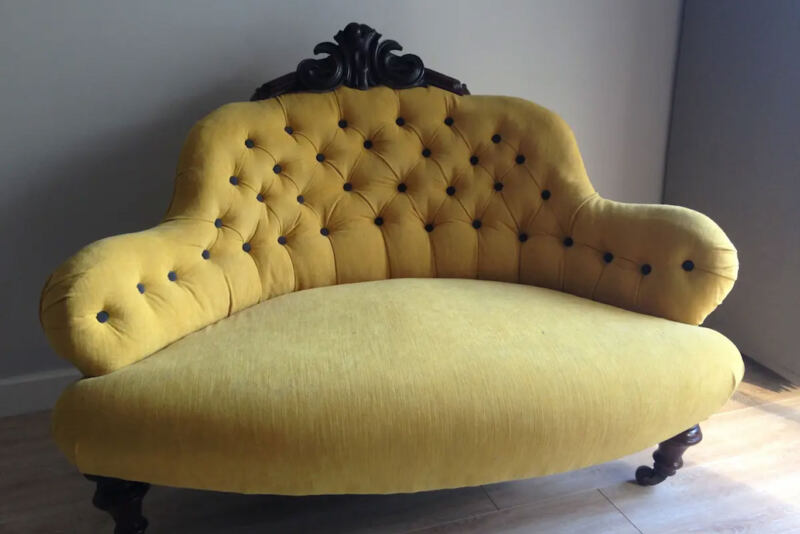
Imagine a traditional button-back chair upholstered in deep green, rust, navy or another confident colour.
The traditional construction remains visible, but the colour can give it a completely different identity.
The important distinction is often between deliberate simplicity and excessive decoration.
A clear block of colour may feel highly contemporary even when applied to a very traditional furniture shape.
Can patterned fabric still work?
Yes.
Reupholstering traditional furniture for a modern interior does not require removing all pattern.
The scale and style of the pattern are what matter.
Traditional furniture can work particularly well with:
- bold geometric designs
- abstract patterns
- oversized motifs
- restrained stripes
- contemporary botanical designs
- simple checks
The contrast between an older frame and an unexpected fabric can become the central design feature.
However, there is a risk of creating visual conflict if the furniture already contains a great deal of decorative detail.
A heavily carved chair with deep buttoning, elaborate piping and a complex multicoloured pattern may contain too many competing elements.
In that situation, simplifying the upholstery can allow the quality of the furniture itself to become more visible.
Should traditional details be removed?
Not automatically.
One of the easiest mistakes when trying to modernise furniture is to assume every traditional feature needs to disappear.
If all identifying characteristics are removed, much of the reason for retaining the original piece can be lost.
Instead, decide which features contribute positively to its character.
These might include:
- shaped arms
- exposed timber
- curved backs
- turned legs
- buttoning
- piping
- decorative studs
Some can be retained while others are simplified.
For example, a buttoned chair might keep its original deep-buttoned back but lose decorative fringe or ornate trim.
A traditional sofa could retain its rolled arms while using a very clean, plain upholstery fabric.
The finished result then feels intentionally transitional rather than unsuccessfully disguised.
Can piping make furniture look more modern?
Yes, depending on how it is used.
Piping defines the outline of upholstered furniture.
Matching piping in the same fabric can create a clean and understated finish.
Contrasting piping creates stronger visual definition.
For example, a pale chair with dark piping can emphasise the shape of the frame and make the piece feel more graphic.
However, too much contrast can also reinforce traditional detailing.
Whether piping feels contemporary depends on the furniture, fabric and surrounding room.
The detail should be assessed as part of the complete piece rather than selected independently.
What about buttons and tufting?
Traditional deep-buttoned upholstery can work surprisingly well in contemporary interiors.
The key is often the fabric around it.
Buttoning in a plain modern fabric can highlight the geometry of the upholstery rather than making it feel old-fashioned.
A buttoned headboard, chair or sofa does not automatically look traditional.
Problems arise when several traditional signals are combined at once, such as ornate timber, elaborate pattern, decorative fringe and highly detailed buttoning.
Removing one or two of those elements can dramatically change the visual balance.
Can exposed wooden frames be updated?
Yes.
Exposed timber can create an attractive contrast with new upholstery.
In some cases, the wood finish itself may already work well with the new room.
Dark timber can provide depth within a pale contemporary interior, while lighter wood can complement Scandinavian-influenced schemes.
The temptation to alter timber simply because it is old should be resisted.
Original wood can be one of the strongest features of a traditional piece.
The key question is whether its tone complements the wider room.
Furniture does not need to match flooring or other timber exactly.
A mix of finishes can work well when the overall palette feels deliberate.
How should you choose colour?
Start with the room rather than the furniture in isolation.
A reupholstered piece needs to relate to its surroundings.
Look at:
- wall colours
- curtains and blinds
- flooring
- rugs
- other upholstered furniture
- timber finishes
- artwork
- cushions and accessories
There are two broad approaches.
Let the furniture blend in
Choose a colour related closely to the room’s existing palette.
This is useful where the furniture already has a strong shape and does not need additional visual emphasis.
Make the furniture a focal point
Use a stronger colour or pattern so the traditional piece becomes a deliberate feature.
This works particularly well when the rest of the room is relatively restrained.
The second approach can make older furniture feel much more intentional.
Instead of appearing to be something that simply remained from a previous interior, it becomes a clear part of the new design.
Can traditional furniture work in a minimalist room?
Yes, but restraint becomes especially important.
Minimalist rooms rely heavily on proportion, shape and space.
A traditional armchair with a distinctive outline can become almost sculptural when surrounded by simpler furniture.
The upholstery should usually support that effect.
A very busy fabric could undermine the simplicity of the scheme, while a plain material allows the shape of the chair to become the point of interest.
One carefully chosen traditional piece can sometimes have more impact than several decorative elements.
Does every piece in the room need the same upholstery style?
No.
Trying to make every sofa and chair match can actually make a room feel less natural.
Contemporary interiors often combine different materials and textures.
A reupholstered traditional armchair might sit alongside a simpler modern sofa.
They can be connected through:
- related colours
- complementary textures
- repeated accent colours
- similar cushion fabrics
- shared timber tones
This allows each piece to retain its own identity.
Matching everything exactly can remove the contrast that made the traditional piece interesting in the first place.
How can upholstery connect old and new furniture?
Fabric can act as a bridge.
Imagine a room containing a modern neutral sofa and an inherited traditional armchair.
The chair does not need the same material as the sofa.
Instead, its new upholstery could use a colour found elsewhere in the room, perhaps in a rug or curtain.
Cushions on the modern sofa could then repeat a small amount of that colour.
The two pieces become visually related even though they are clearly from different periods.
This type of coordination often feels more natural than trying to make older furniture imitate something new.
Can you modernise a traditional sofa without making it plain?
Absolutely.
Contemporary does not have to mean minimal.
The sofa can still have character.
A traditional frame could use:
- a large-scale geometric fabric
- a rich velvet
- a textured weave
- contrasting cushions
- strong piping
- a contemporary colour combination
The objective is not necessarily simplification for its own sake.
It is to make conscious choices about which features should be emphasised.
If the sofa has a relatively simple frame, there may be more freedom to use an expressive fabric.
If it already has ornate detailing, the upholstery might need to be quieter.
What happens if the new fabric is too modern for the furniture?
Contrast can be effective, but it still needs to feel coherent.
A highly technical-looking material or extremely stark pattern may occasionally fight against the proportions and construction of a traditional piece rather than refreshing it.
That does not mean unconventional combinations should be avoided.
It means they should be assessed at a realistic scale.
Small fabric samples can make bold choices appear easier to live with than they will be across an entire sofa.
Look at the fabric against the actual furniture if possible and consider how much surface area it will cover.
The more distinctive the furniture shape, the more carefully fabric scale should be judged.
When is reupholstery better than replacing furniture?
Reupholstery may make sense when the existing piece has qualities worth preserving.
That might be because:
- the proportions suit the room
- the frame is well made
- the furniture is comfortable
- it has sentimental value
- its design is difficult to replace
- you want to retain a distinctive piece
- only the upholstery no longer suits the interior
Replacement may be more appropriate where the furniture no longer suits the room function, dimensions or comfort requirements.
The decision should therefore go beyond whether the fabric looks dated.
Ask whether you would still want the same piece if its upholstery were completely different.
If the answer is yes, recovering it may be worth exploring.
Can reupholstery help avoid a room looking too new?
Yes.
A completely new interior can sometimes feel visually flat when every item has been selected at the same time and from a similar design period.
Introducing an older piece can create contrast and depth.
A reupholstered traditional chair or sofa brings its existing shape and history while the new fabric connects it to the updated room.
The result can feel more collected and personal.
This is one of the strongest reasons not to treat traditional furniture as something that automatically needs replacing during a renovation.
What should you decide before choosing upholstery fabric?
Before becoming focused on colour samples, define the objective.
Ask:
- What do you like about the existing furniture?
Identify the features that deserve to remain visible. - What currently makes it feel dated?
It may be the fabric rather than the frame. - Should the piece blend in or stand out?
This determines how bold the new material should be. - How will it be used?
A frequently used sofa may need a different practical specification from an occasional chair. - What other fabrics are already in the room?
The upholstery should work alongside curtains, blinds, rugs and other furniture. - Which original details should remain?
Decide whether features such as piping, buttons or trims still contribute to the design.
This creates a much clearer brief than simply asking for something “more modern”.
Frequently Asked Questions
Can an antique chair be upholstered in modern fabric?
Yes. The contrast between a traditional frame and contemporary fabric can work particularly well. The condition and value of the piece should be considered before alterations are made, especially with genuinely important antiques.
Does reupholstery change the shape of a sofa or chair?
The fundamental frame remains the same, although padding and upholstery work can affect the finished contours. Reupholstery is generally better for changing the surface character of a piece than completely altering its basic proportions.
Can different fabrics be used on one piece of furniture?
Potentially, yes. Contrasting fabric on backs, cushions or piping can create a more contemporary result, although the combination should be carefully coordinated.
Should old furniture be reupholstered in its original style?
Not necessarily. If historical authenticity is important, preserving the original character may be appropriate. For furniture intended for everyday use in a contemporary home, there is much more scope to reinterpret it through fabric and detailing.
Can reupholstered furniture work with modern curtains and blinds?
Yes. Upholstery can be coordinated with window treatments through shared tones, complementary textures or carefully repeated accent colours without using exactly the same material.
Traditional furniture does not need to be replaced simply because an interior is becoming more contemporary.
Reupholstery can preserve the craftsmanship, proportions and character of an existing piece while changing the elements that most strongly influence how it feels within the room.
The most effective approach is usually selective rather than transformational. Retain the features that make the furniture distinctive, then use fabric, colour and detailing to connect it with the new scheme.
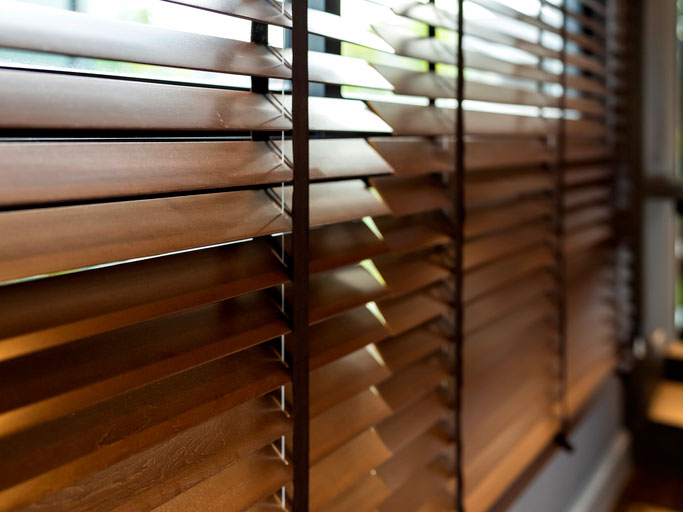
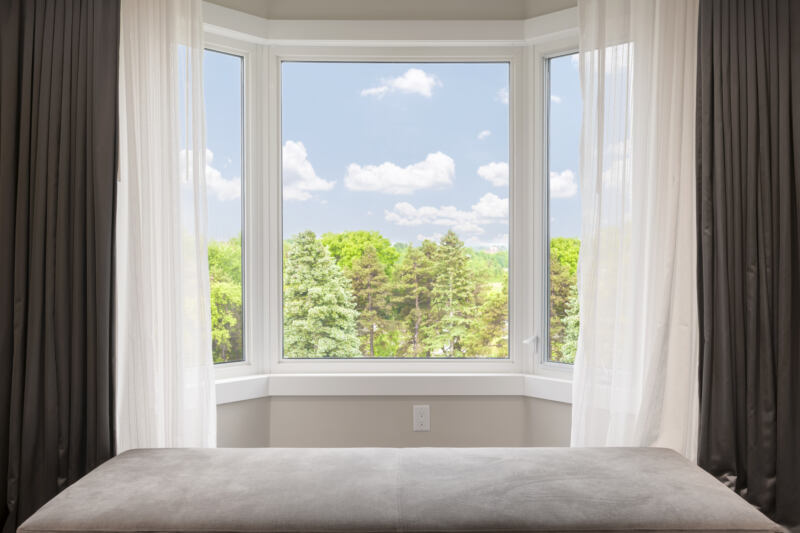
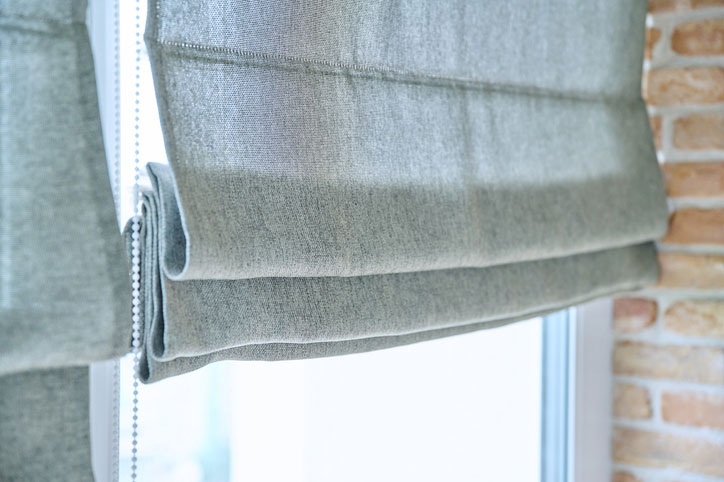
Zenn Interiors provides bespoke upholstery alongside made-to-measure curtains and blinds, allowing furniture and window treatments to be considered together as part of a cohesive interior.
Phone: 020 7871 3082
Email: zenninteriors@gmail.com
Find out more: https://zenninteriors.co.uk/